11 Days Through the Italian Dolomites and Austrian Alps: A Hiking and Road Trip Adventure
An 11-day journey through Italy and Austria that proved the best views often come from the unexpected path.
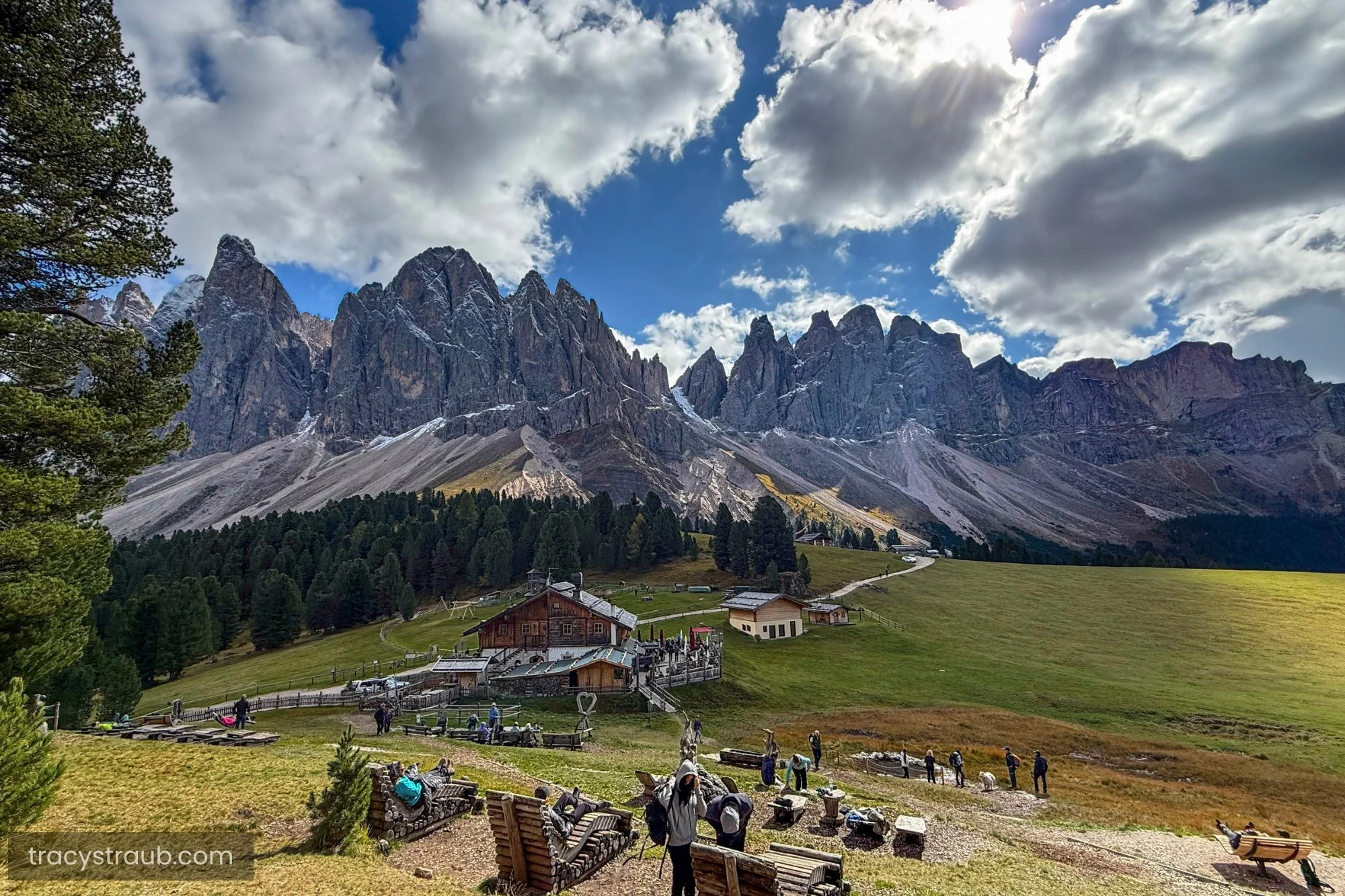
We’ve logged a lot of miles on some of the world’s most iconic trails, but this trip reminded us that experience does not protect you from unpredictable weather or from the need to pivot when the plan stops making sense. That quick shift ended up giving us a better trip, clearer skies, and an itinerary we never would have built otherwise. And honestly, it is the same lesson that shows up in day-to-day life and work: you can plan all you want, but the ability to adapt is what actually moves you forward.
Travel rarely goes exactly as planned, and that is often where the experience becomes most interesting. Our trip to the Dolomites began with a forecast that forced us to rethink everything. Days of rain were headed for northern Italy, and the hikes we had mapped out were unlikely to have the visibility we hoped for, a reminder before we even left the airport that sometimes the smartest move is the pivot.
Since we were still within the window to shift a few reservations, we paused, checked the weather patterns, and rerouted the start of our itinerary into Austria instead. Clearer skies and a slower pace made the decision easy, and it ended up shaping the trip in the best way.
From landing in Venice to driving north toward the Austrian Alps, the journey unfolded differently than expected but in a way that felt exactly right. The detour did not just save the trip; it made it better. It is the simplest reminder: the plan matters, but the pivot is what makes the story.
Download Dolomites Digital Travel Guide
Days 1–2: Arrival in Venice & Hallstatt in the Austrian Alps
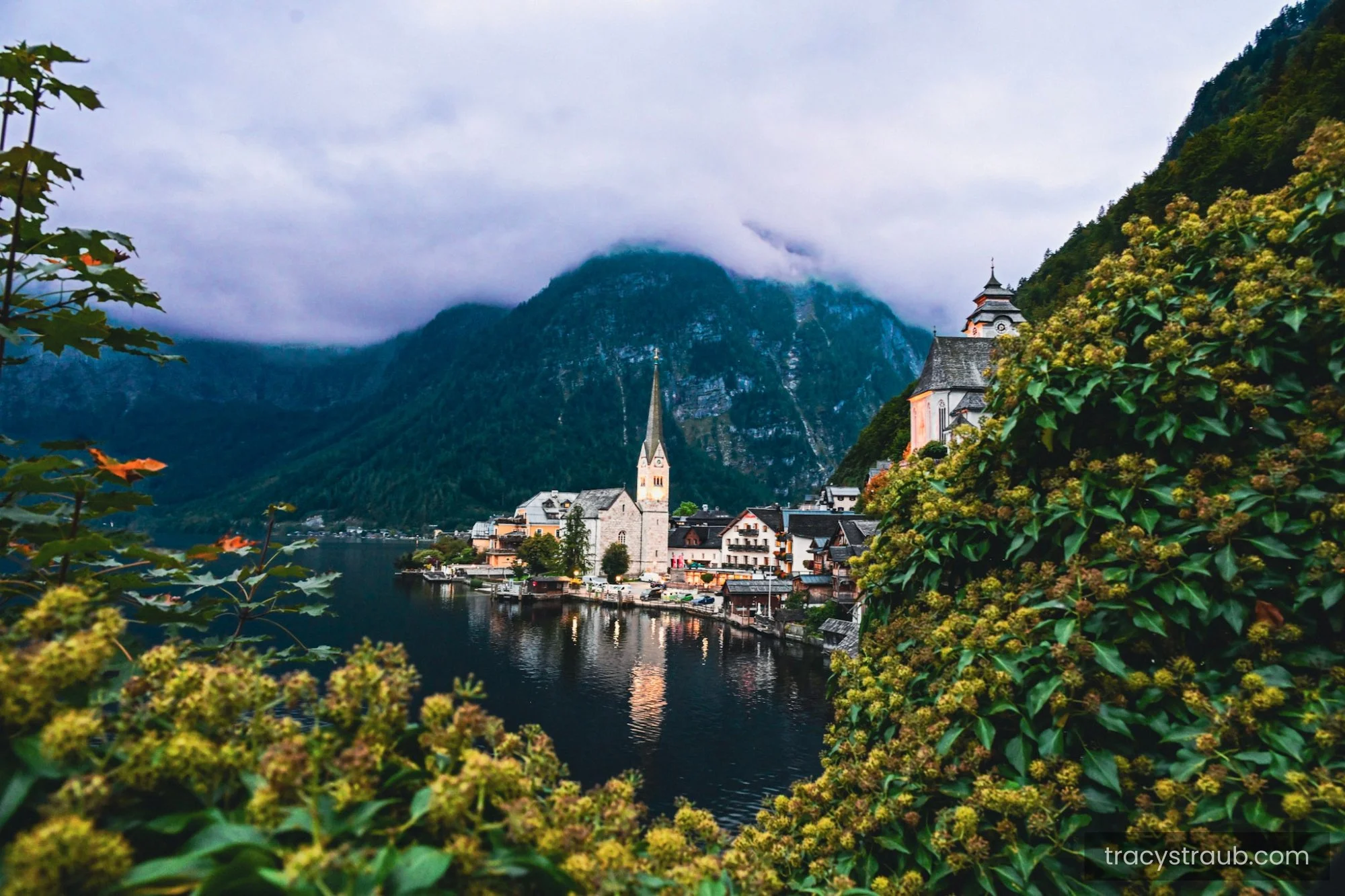
Evangelical Church of Hallstatt, Hallstatt, Upper Austria, Austria
After an easy check-in at Charleston’s Yeager Airport, we headed for Venice with a quick connection in Atlanta on an overnight Delta flight. By mid-morning the next day, we were walking through Marco Polo Airport, a little tired but ready to see how our newly adjusted plan would unfold.
Once we picked up our rental car, we made a quick stop at a nearby ENI gas station to buy an Austrian highway vignette. This small toll sticker is required for using Austria’s major roads and is easy to find at stations near the border. We chose the 10-day option, which fit perfectly with the amount of time we planned to spend exploring before circling back into Italy.
Leaving the Venetian plains behind, we drove north into the alpine valleys and then into the Salzkammergut region, where Hallstatt sits between the Dachstein mountains and a quiet blue lake. By late afternoon, a light mist drifted over the water and the air had cooled, giving the village a peaceful, almost otherworldly feel.
Hallstatt’s historic center is mostly car-free, so we parked in one of the designated lots (P1–P3) just outside town. A free shuttle runs every 30 minutes and drops visitors near the lakeside promenade. From there, we walked the cobblestone streets lined with pastel houses, flower-filled balconies, and the sound of church bells echoing across the lake.

Braugasthof Lobisser Gasthof, Hallstatt, Upper Austria, Austria
We stayed at Braugasthof Lobisser Gasthof, a cozy inn with lake front views that glowed gold at sunset. We arrived just before 6:45 p.m., right before the kitchen closed at 7 p.m. The kind staff offered to keep it open, but we opted for a short evening walk through town, eventually finding a small lakeside stand serving warm sandwiches and crispy pommes frites.
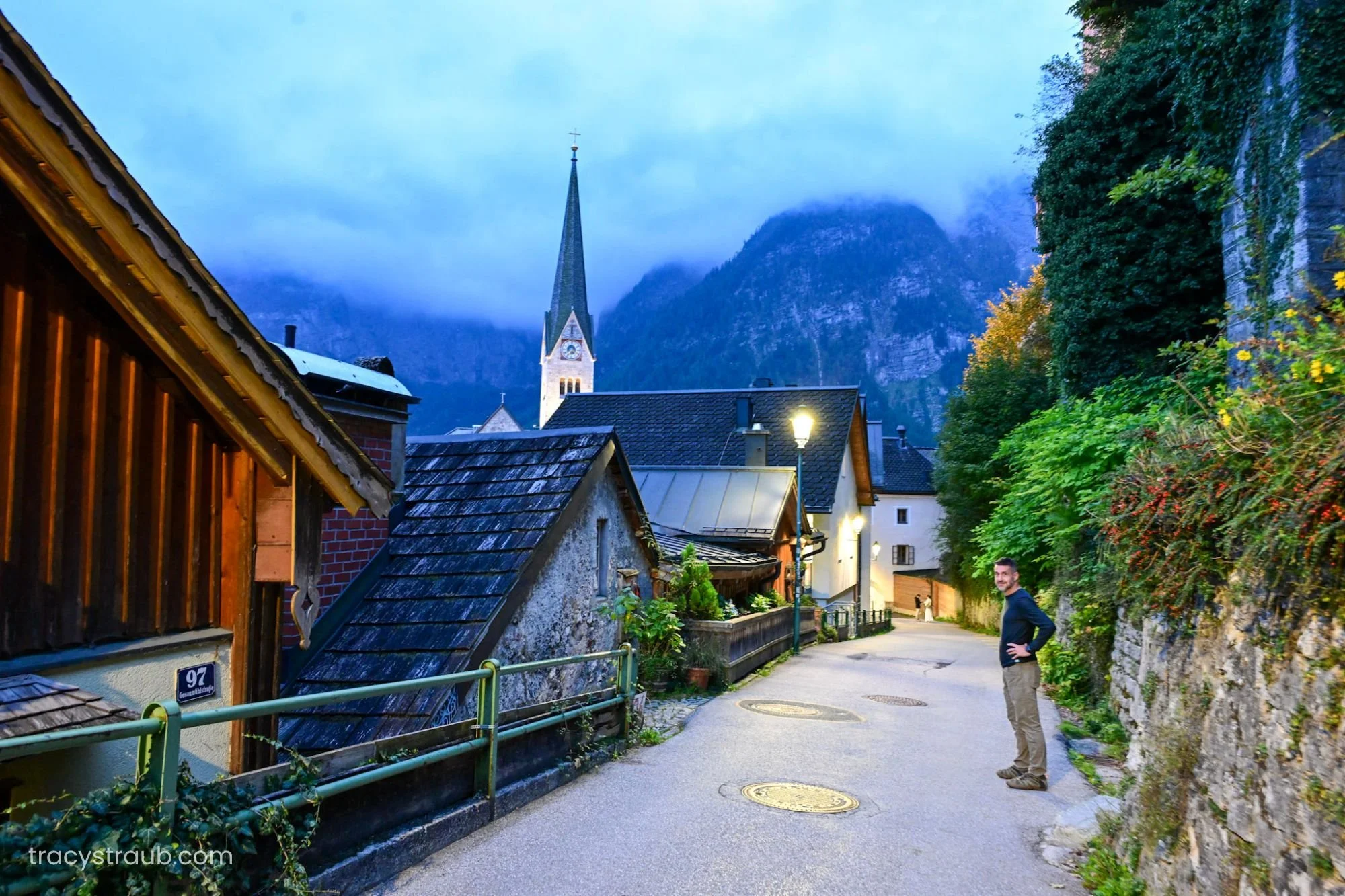
Hallstatt, Upper Austria, Austria
With dinner in hand, we sat by the water as the light faded and the village reflections stretched across the lake. Evening in Hallstatt was calm and quiet, with a stillness that made the moment easy to appreciate.
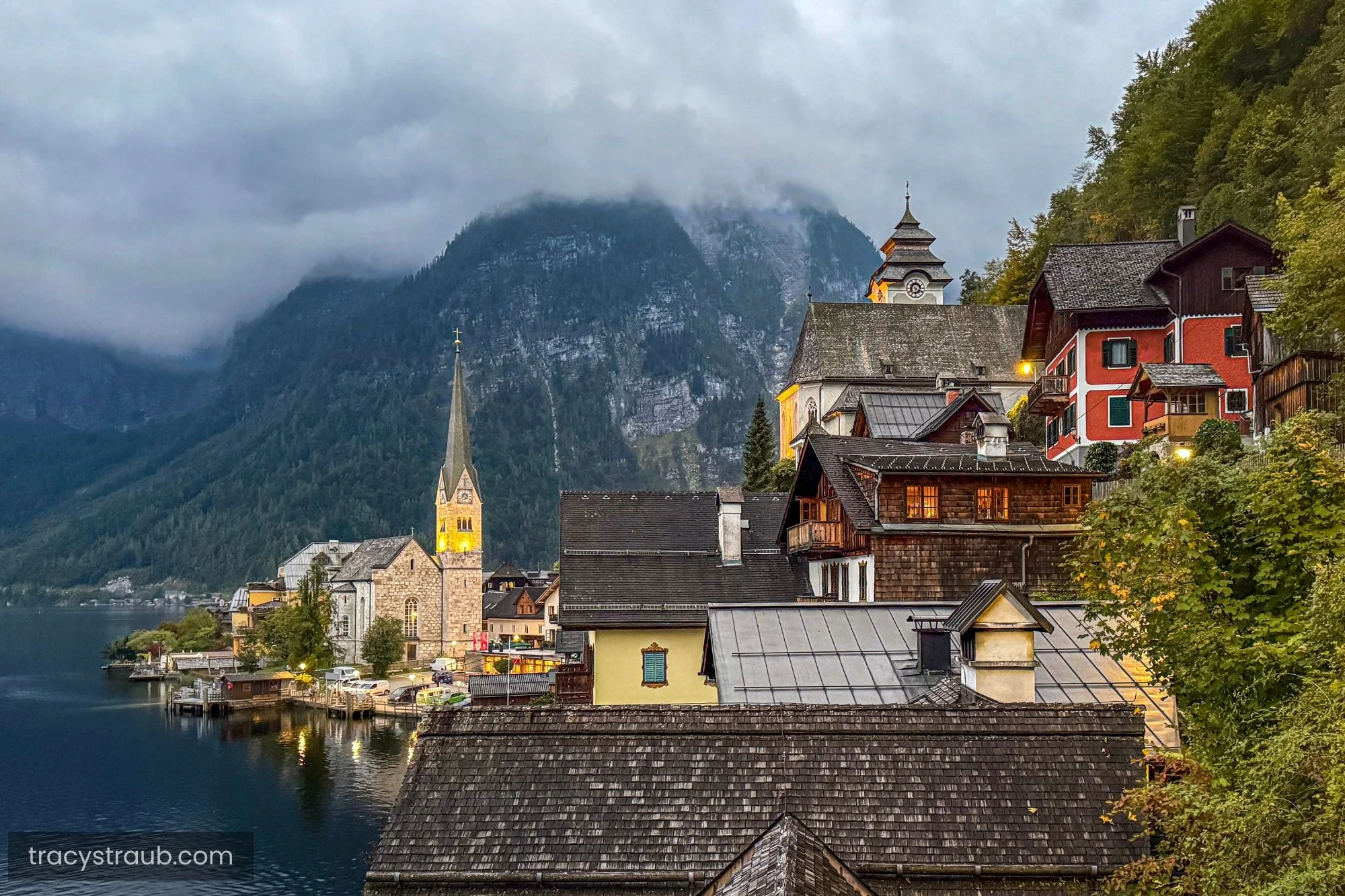
Evangelical Church of Hallstatt, Hallstatt, Upper Austria, Austria
Breakfast the next morning featured a lovely spread of fresh breads, cheeses, fruit, and coffee, served in a cozy dining room.

Breakfast at the Braugasthof Lobisser Gasthof in Hallstatt, Upper Austria, Austria
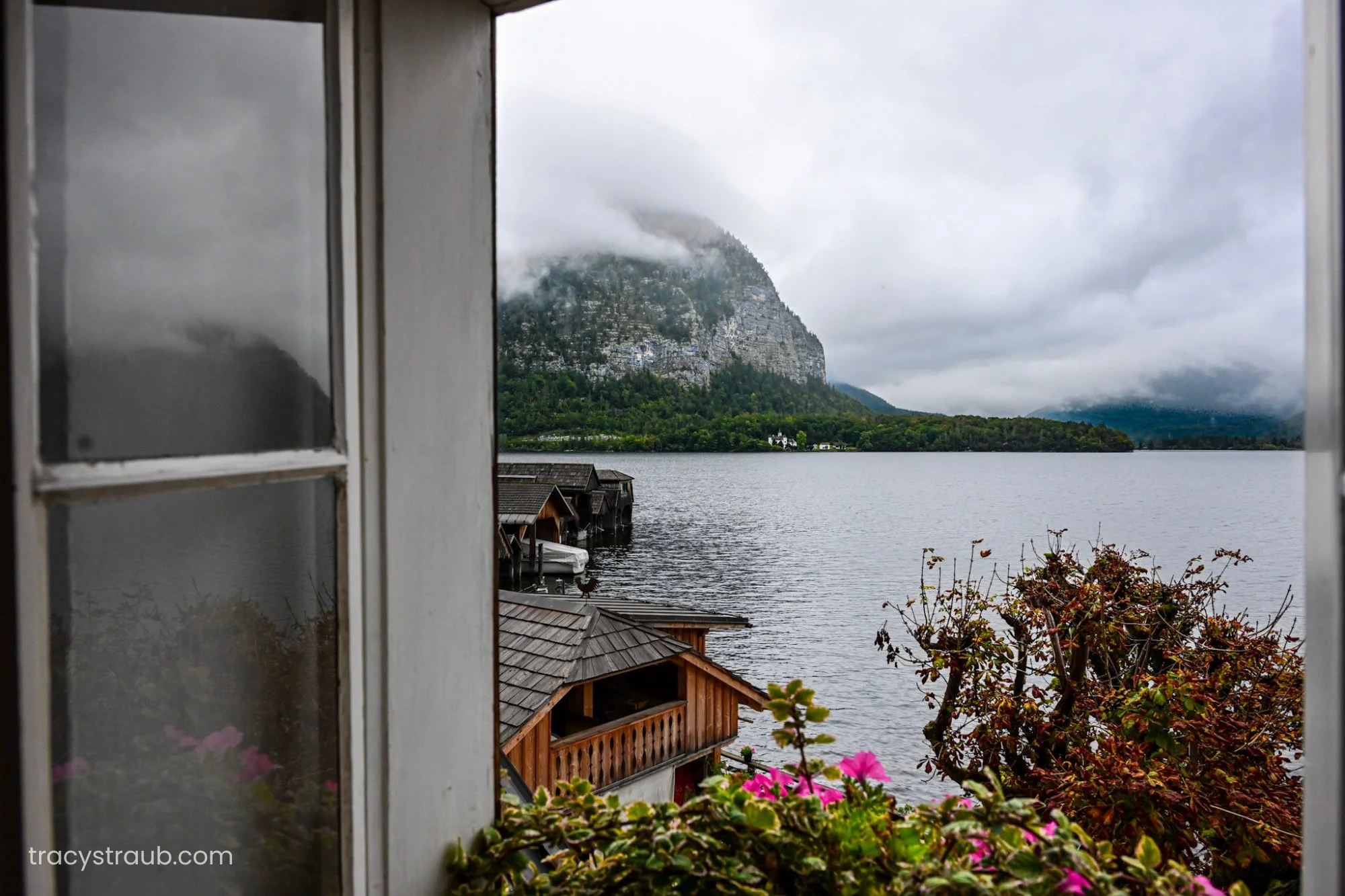
Morning lakefront view at Braugasthof Lobisser Gasthof in Hallstatt, Upper Austria, Austria.
✈️ Travel Notes: Venice to Hallstatt
Rental Car: Picked up at Avis, Venice Marco Polo Airport. Be prepared for this process to take at least an hour.
Austrian Vignette: Vignette purchased at an ENI gas station near the airport
Drive Time: About 4.5 hours from Venice airport to Hallstatt
Parking in Hallstatt: For parking, use P1–P3 lots outside town; free shuttle va run every 30 minutes
Where We Stayed: Braugasthof Lobisser Gasthof, Hallstatt, a charming lakeside inn with traditional Austrian style
Tip: Arrive before 7 p.m. if you plan to dine at this hotel, as kitchens in small alpine villages often close early. Also, have euros on hand as some restaurants (this one included) was cash only.
Photography Tip: The classic Hallstatt viewpoint is near the Hallstatt Lahn ferry dock, best captured around dusk or early morning when the lake is calm
Day 3: Scenic Drive Through the Austrian Alps to Mayrhofen
Leaving Hallstatt, we began our drive toward Mayrhofen, winding through alpine valleys and storybook Austrian towns. The route itself was a highlight, filled with natural wonders and easy scenic stops that made the day feel like an adventure all its own.
Our first stop was Gollinger Wasserfall, located just outside the village of Golling an der Salzach. The short forest walk leads to a beautiful two-tiered waterfall tumbling over moss-covered rock. It is an easy and rewarding stop that sets the tone for the journey ahead.

Gollinger Wasserfall, Wasserfallstraße 23, 5440 Golling an der Salzach, Austria
Next, we visited Lammerklamm Gorge near Scheffau am Tennengebirge, where a wooden walkway winds through a narrow canyon carved by centuries of rushing water. The gorge is compact and easy to explore, offering a dramatic perspective of Austria’s natural landscape.
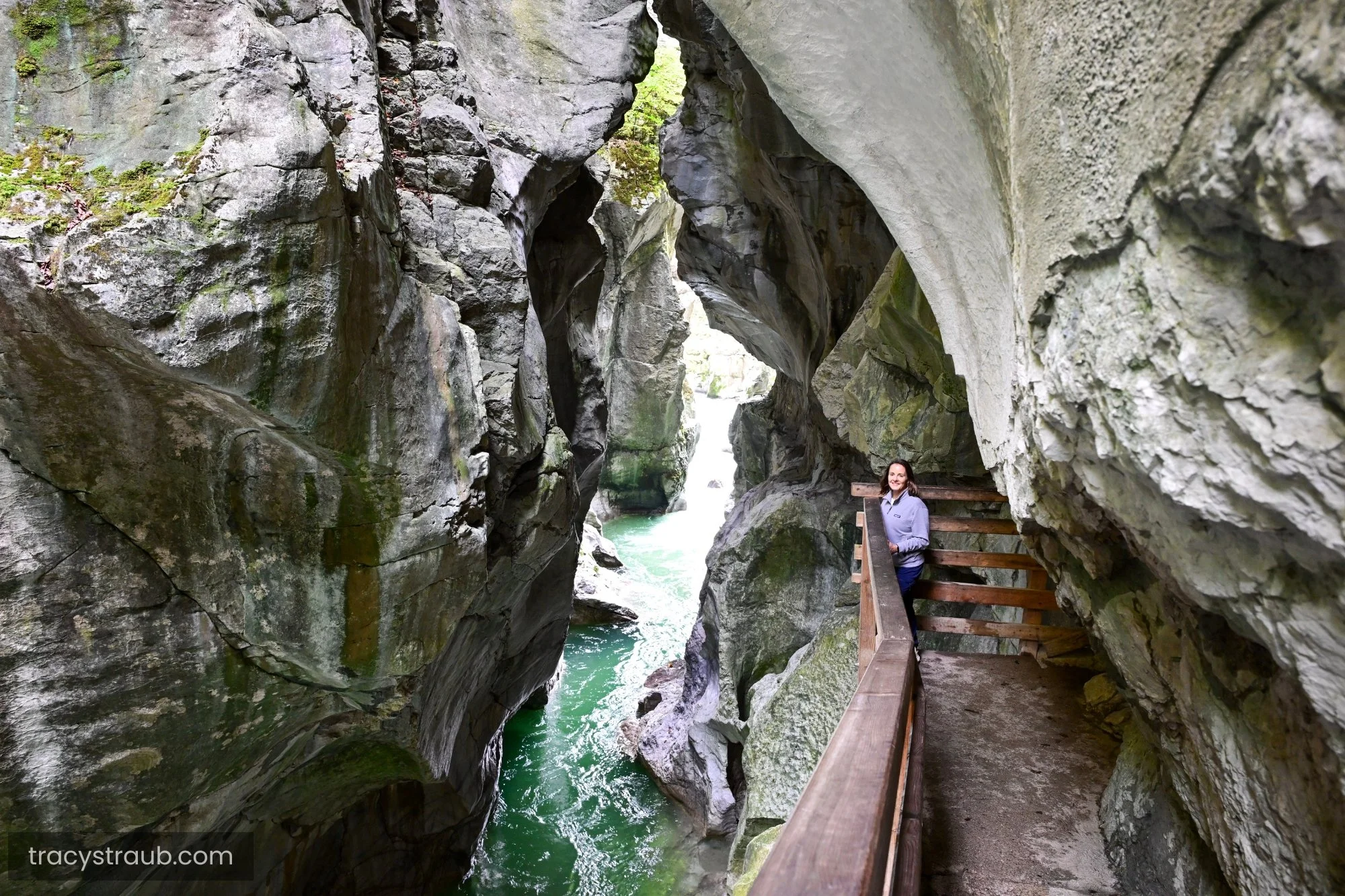
Lammerklamm Gorge, Scheffau 50, 5440 Scheffau am Tennengebirge, Austria
A bit farther along the route, Liechtensteinklamm revealed another world of water and stone. Known as one of the deepest gorges in the Alps, it features a dramatic spiral staircase and powerful waterfalls that seem to disappear into the mist below.
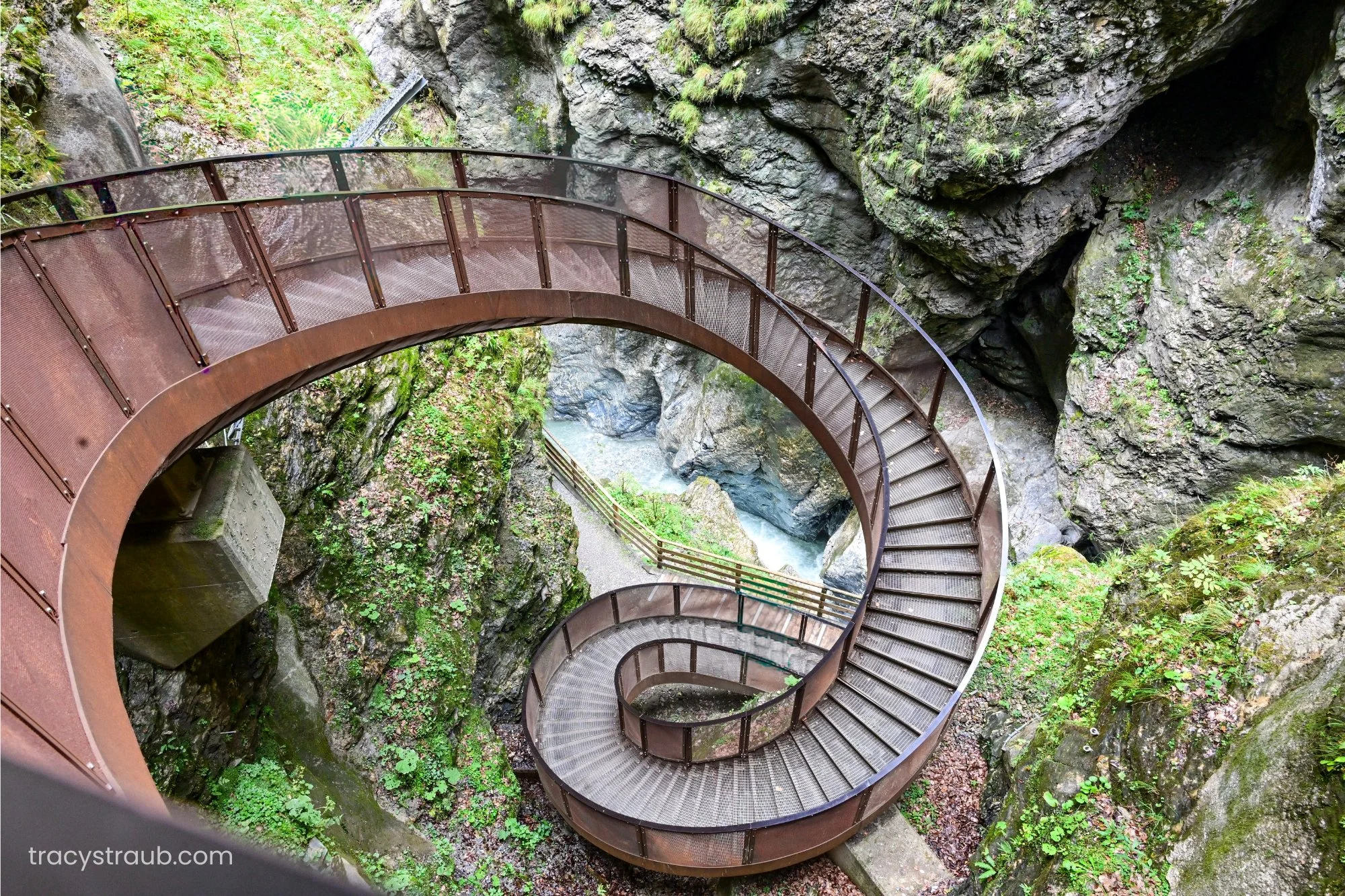
Liechtensteinklamm, Liechtensteinklammstraße 123, 5600 St. Johann im Pongau, Austria
Our final stop of the day was Krimml Waterfalls, located near the village of Krimml in Hohe Tauern National Park. The Krimml Falls are the highest in Austria and among the tallest in Europe, cascading more than 1,200 feet (380 meters) in three dramatic tiers. The scenic trail follows the falls upward with several viewpoints along the way, offering breathtaking photo opportunities and a cool mist in the air. Parking and entry are well organized, and the short walk to the lower viewpoint makes it accessible for most visitors.

Krimml Waterfalls is Located near the village of Krimml in the Hohe Tauern National Park
By late afternoon, we arrived at Huber’s Boutique Hotel in Mayrhofen, where the staff warmly welcomed us and surprised us with a complimentary upgrade to a junior suite featuring a free-standing clawfoot tub, private balcony, and views of the lovely gardens.
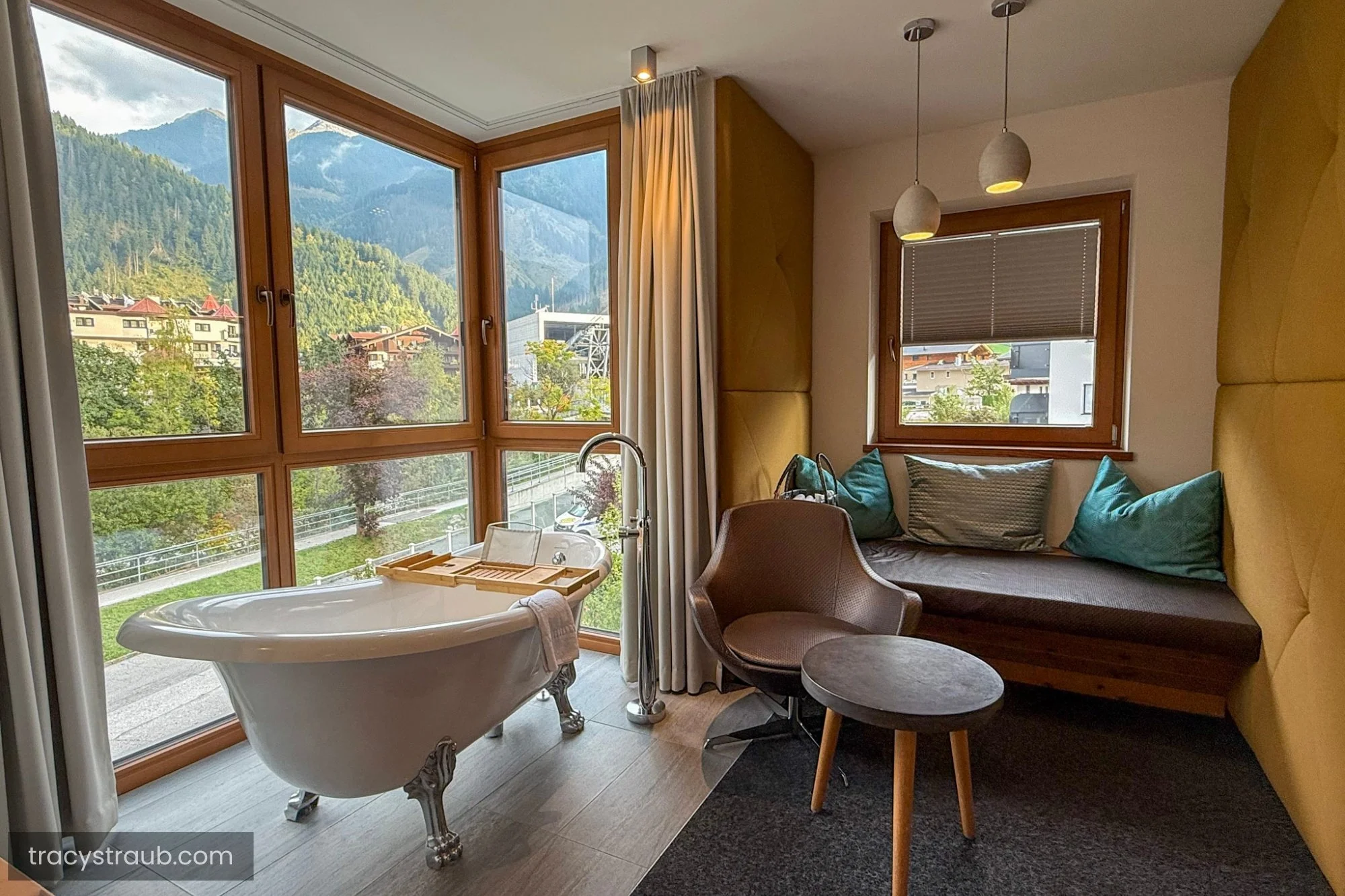
Junior Suite at Huber’s Boutique Hotel in Mayrhofen, Tyrol, Austria
They also provided local hiking maps and suggested several alternate trails in the region, noting that some lesser-known routes offered better views than the popular Olpererhütte hike we had originally planned for the next morning.
After checking in, we took a short walk through Mayrhofen as a light rain began to fall. The streets were calm, and the mountains were wrapped in a soft mist.
We stopped for dinner at Goldkind, a modern farm-to-table restaurant in town. Inside, the space glowed warmly against the gray evening outside, the kind of cozy light that made the whole place feel inviting. We enjoyed a relaxed meal with cocktails while the rain continued outside, a simple and comfortable evening that felt perfectly in sync with the weather.

Mayrhofen, Tyrol, Austria
🚗 Travel Notes: Hallstatt to Mayrhofen
Drive Time: About 4 hours without stops; allow 6–8 hours to enjoy scenic detours
Entrance Fees:
Gollinger Wasserfall: €7 per adult
Lammerklamm Gorge: €9 per adult
Liechtensteinklamm: €15 per adult
Dining: Goldkind, Mayrhofen – creative seasonal menu with vegetarian options and local ingredients
💫 Lodging Highlight: Huber’s Boutique Hotel, Mayrhofen, Austria
Tucked in the heart of Mayrhofen, Huber’s Boutique Hotel is the first boutique hotel in the Zillertal Alps — a modern, cozy, and slightly extravagant retreat designed to blend nature and architecture in perfect balance.
Our stay here was such a highlight that we wished we had arrived earlier to enjoy more time. Each detail felt thoughtful: spacious rooms with private balconies, mountain views, and soft lighting that made the entire space feel calm and restorative.
Guests enjoy a gourmet breakfast, an afternoon pastry and cake buffet, and full access to the hotel’s GREEN SPA wellness oasis, which features a heated indoor-outdoor pool, panoramic sauna, bio sauna, saline steam bath, and relaxation lounge with mountain views. Hiking poles and backpacks are available at reception, along with a secure bike and ski room, free parking, and complimentary Wi-Fi.
After a long day of exploring the Zillertal Alps, sinking into the spa’s infrared loungers or enjoying a drink by the pool is pure bliss. Huber’s truly lives up to its motto: experience the unexpected, at its very source.
Days 4–5: Crossing Into Italy and Settling Into Val Gardena, Dolomites
We woke to steady rain and decided to take our one lazy morning of the trip. Instead of heading out to hike, we lingered in our beautiful room and enjoyed a long, unhurried breakfast at Huber’s. The delicious breakfast was included in our room package, and it was such a lovely experience: fresh breads, local cheeses, fruit, made-to-order omelets and waffles, and strong coffee served in a bright dining room overlooking the garden and mist-covered mountains.

Huber’s Boutique Hotel, Dornaustraße 612, 6290 Mayrhofen, Tyrol, Austria
Before we left, the staff handed us a small jar of homemade jam as a parting gift. We packed it away without thinking much about it, but it ended up becoming our go-to breakfast addition for the rest of the trip. Most mornings in Italy started with fresh bread, coffee, and that jar of jam at our various Airbnbs.
As we crossed back into Italy, the landscape shifted again. Austria’s sharp alpine peaks gave way to gentler slopes, chalets, and larch trees just starting to turn yellow. The rain finally cleared, opening patches of blue sky, so we made our way to the Gardena Pass overlook.
From the viewpoint, surrounded by wide open ridgelines and peaks in every direction, it felt like the real beginning of this part of the trip.
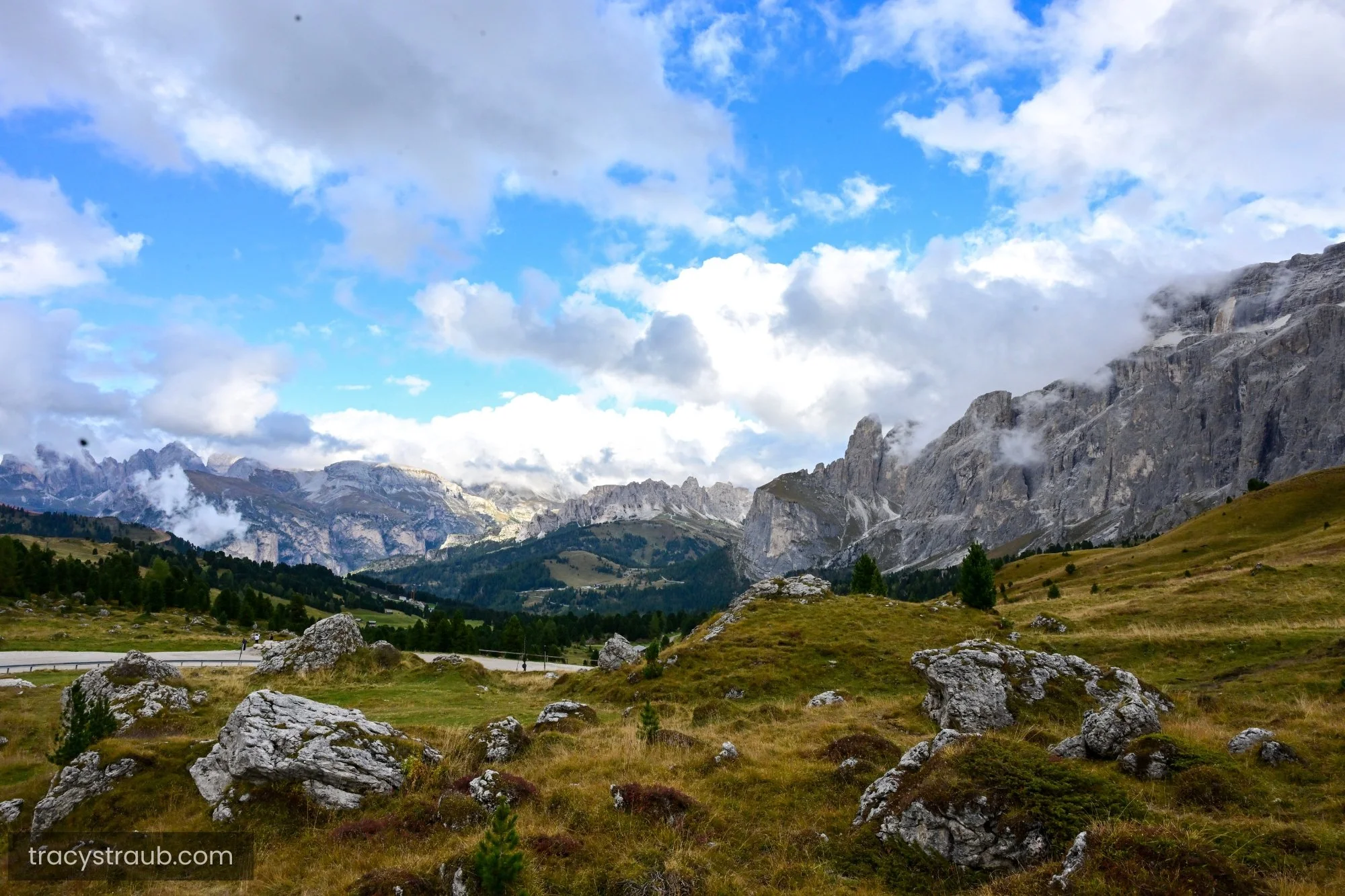
Gardena Pass (Passo Gardena), South Tyrol, Italy
From there, we continued on to Ortisei, a picturesque alpine town filled with colorful facades, boutique shops, and cobblestone streets.
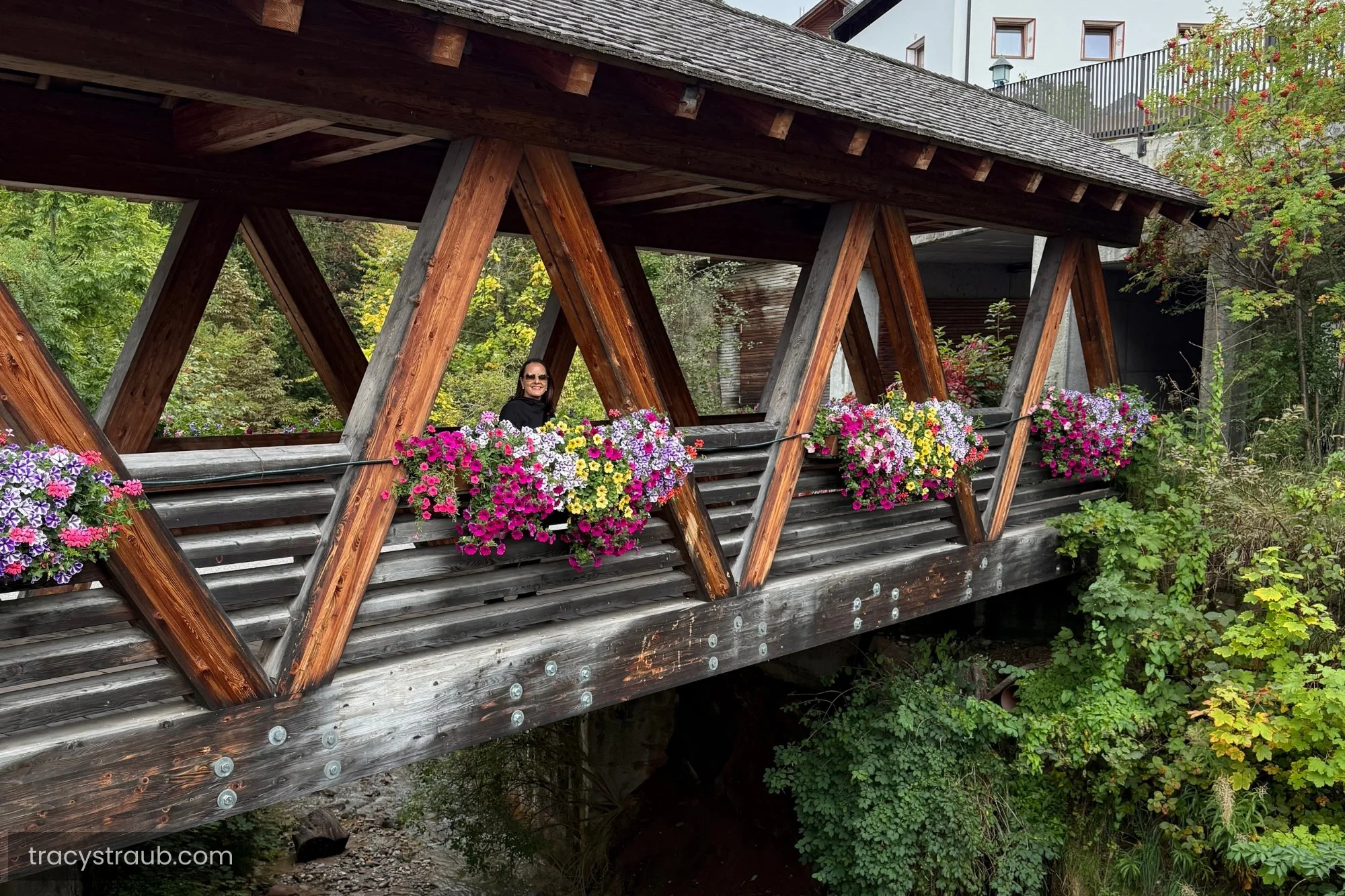
Flower-covered St. Antonius Footbridge in Ortisei, Italy, spanning the Rio Anna in the heart of Val Gardena.
The rain eased to a drizzle as we wandered through the town center, grabbed espressos, and then settled in for our first pizza in Italy at Cascade, a cozy spot overlooking the river.
After a late lunch, we made the short drive to Santa Cristina and checked into our Airbnb. Our host greeted us on arrival, gave a quick tour, and collected the tourist tax of €2.50 per person per night in cash.
The location could not have been better. A coffee shop sat just across the street, a grocery and several restaurants were within easy walking distance, and L Fudlè, a cozy restaurant and pizzeria, was conveniently next door.
That evening, we went there for dinner and immediately fell in love with the place. The warm glow from the windows spilled onto the street, and inside, wood-paneled walls and friendly chatter created a welcoming, mountain-village atmosphere.
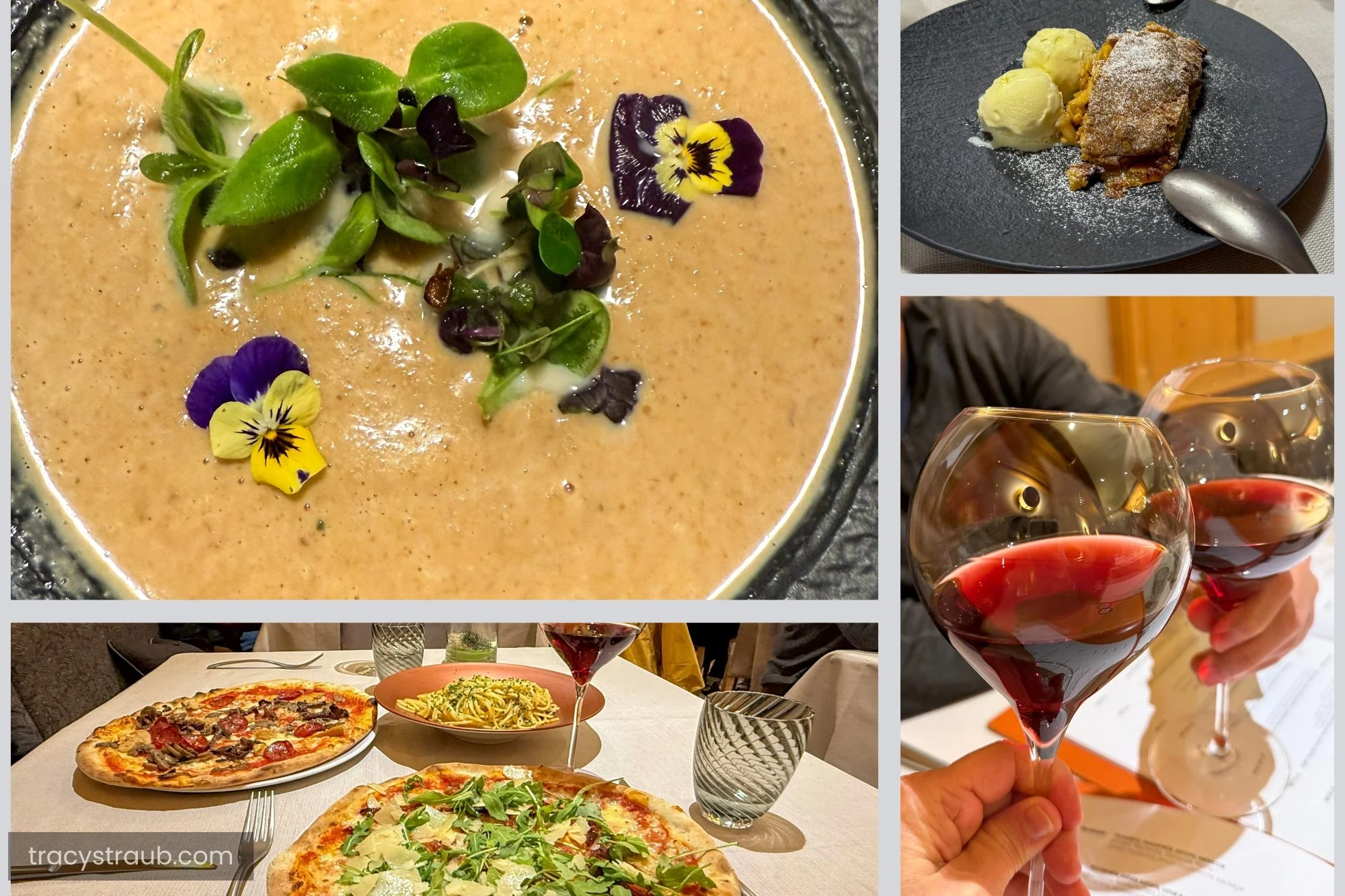
Dining at L Fudlè Restaurant in Santa Cristina, Val Gardena, Italy
The meal was so enjoyable that we returned twice more during our stay. The combination of mountain air, welcoming locals, and delicious food made Val Gardena feel like home almost immediately.
🏔️ Travel Notes: Mayrhofen to Val Gardena
Drive Time: About 3.5 hours with scenic stops
Border Crossing: Austria to Italy via the Brenner Pass
Recommended Stop: Ortisei – known for shopping, cafés, and access to the Seceda cable car area
Where We Stayed: Airbnb in Santa Cristina, Val Gardena – centrally located with walkable access to cafés, groceries, and restaurants
Local Taxes: Tourist tax collected in cash (€2.50 per person per night)
Dining:
Cascade, Ortisei – riverside pizzeria and café, great for a relaxed lunch
L Fudlè, Santa Cristina – cozy restaurant and pizzeria with warm service, friendly English-speaking staff, and excellent pasta and pizza
Photography Tip: If weather allows, stop at the Gardena Pass overlook (Passo Gardena) just beyond town for your first panoramic view of the Dolomites. Early evening light is best for photos.
Day 6: Hiking the Seceda Ridgeline & Alpe di Siusi in the Dolomites
We were up early for one of the Dolomites’ most iconic views, the Seceda ridgeline. After grabbing croissants and cappuccinos from the café across the street, we drove to Ortisei, about ten minutes from our Airbnb in Santa Cristina, and parked in the garage beside the Seceda cable car station.
The Seceda lift (two connected cableways called the Ortisei–Furnes and Furnes–Seceda) climbs nearly 2,500 meters to the top of the ridge. We had purchased a Dolomiti Supersummer 5 Giorni su 7 Pass online in advance, which allowed us five lift-access days within a seven-day window and saved money compared to buying individual tickets.
As we climbed higher, the landscape shifted quickly. The green meadows in the valley gave way to fresh snow from the night before. By the time we reached the top, the ridge was completely covered, and the trail looked like a different season. Seeing the hillside change from summer conditions to winter in just a short hike was a surprising contrast.
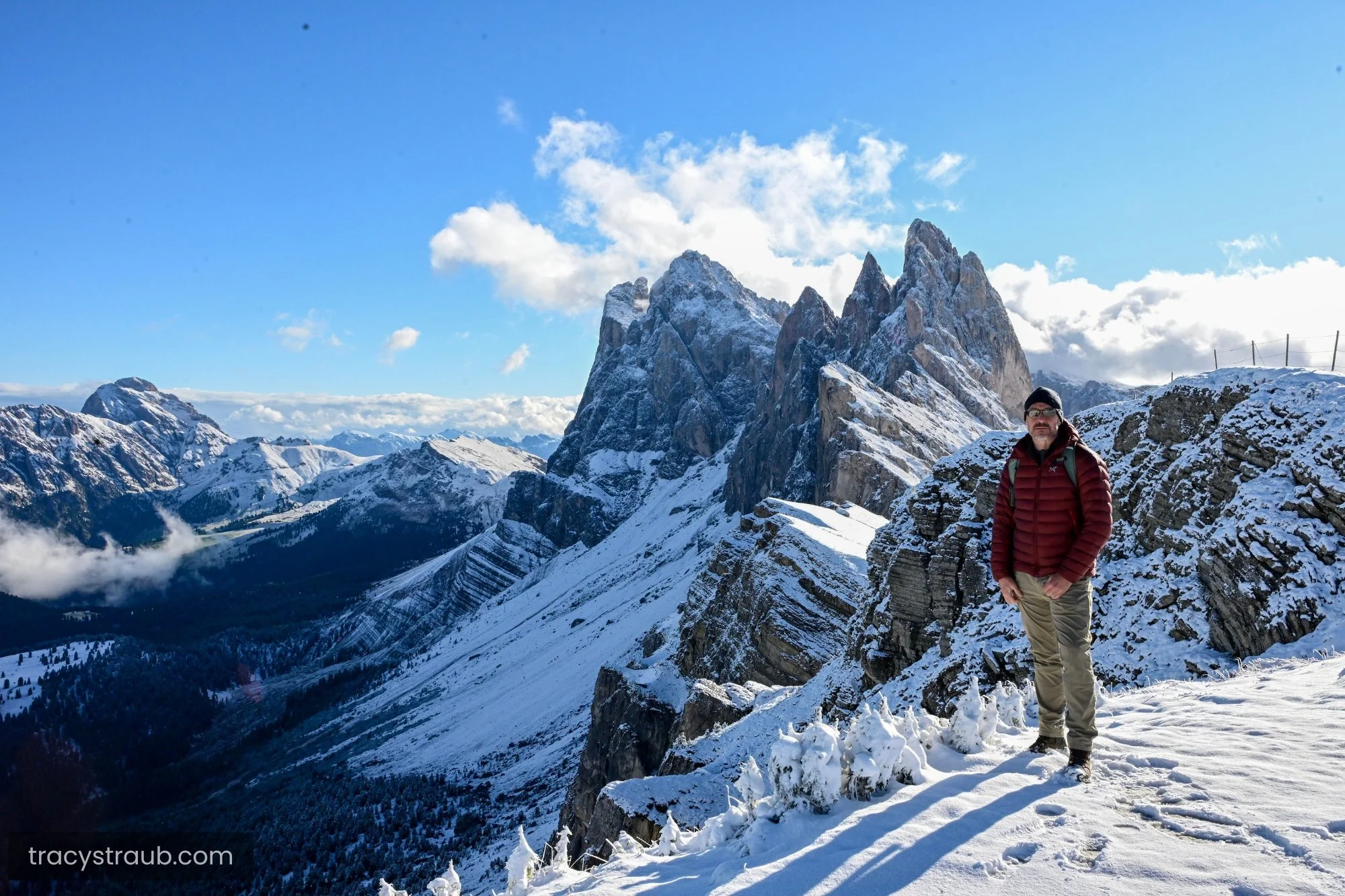
Panoramic views of the Odle Peaks from the summit of the Seceda Ridgeline, Ortisei, Val Gardena, South Tyrol, Italy
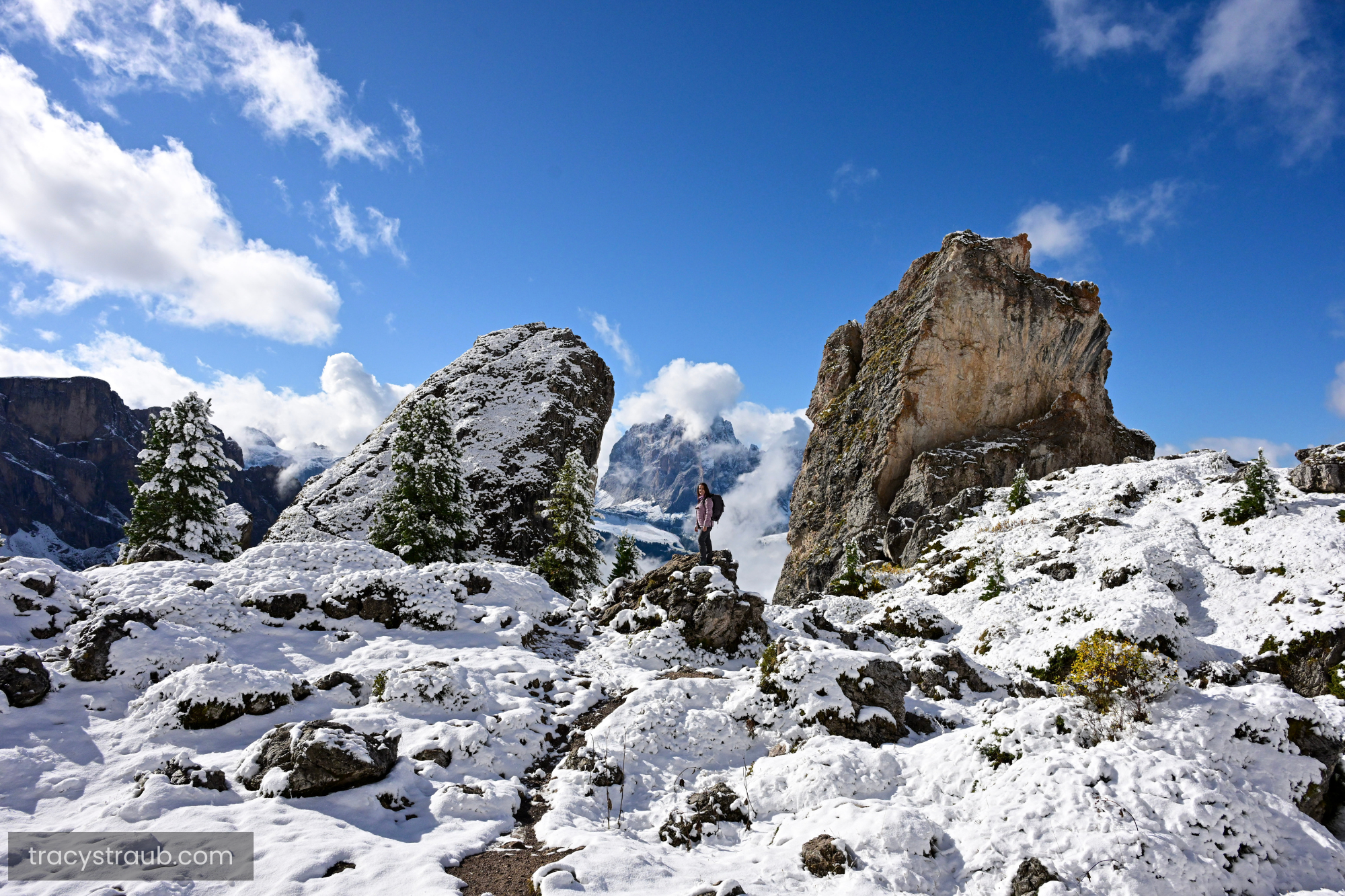
Seceda Ridgeline, Ortisei, Val Gardena, South Tyrol, Italy
Midway along the ridge, we stopped at Malga Pieralongia Alm-Schwaige, a rustic mountain hut surrounded by wide views of the Odle peaks. It quickly became one of my favorite rifugios of the trip.
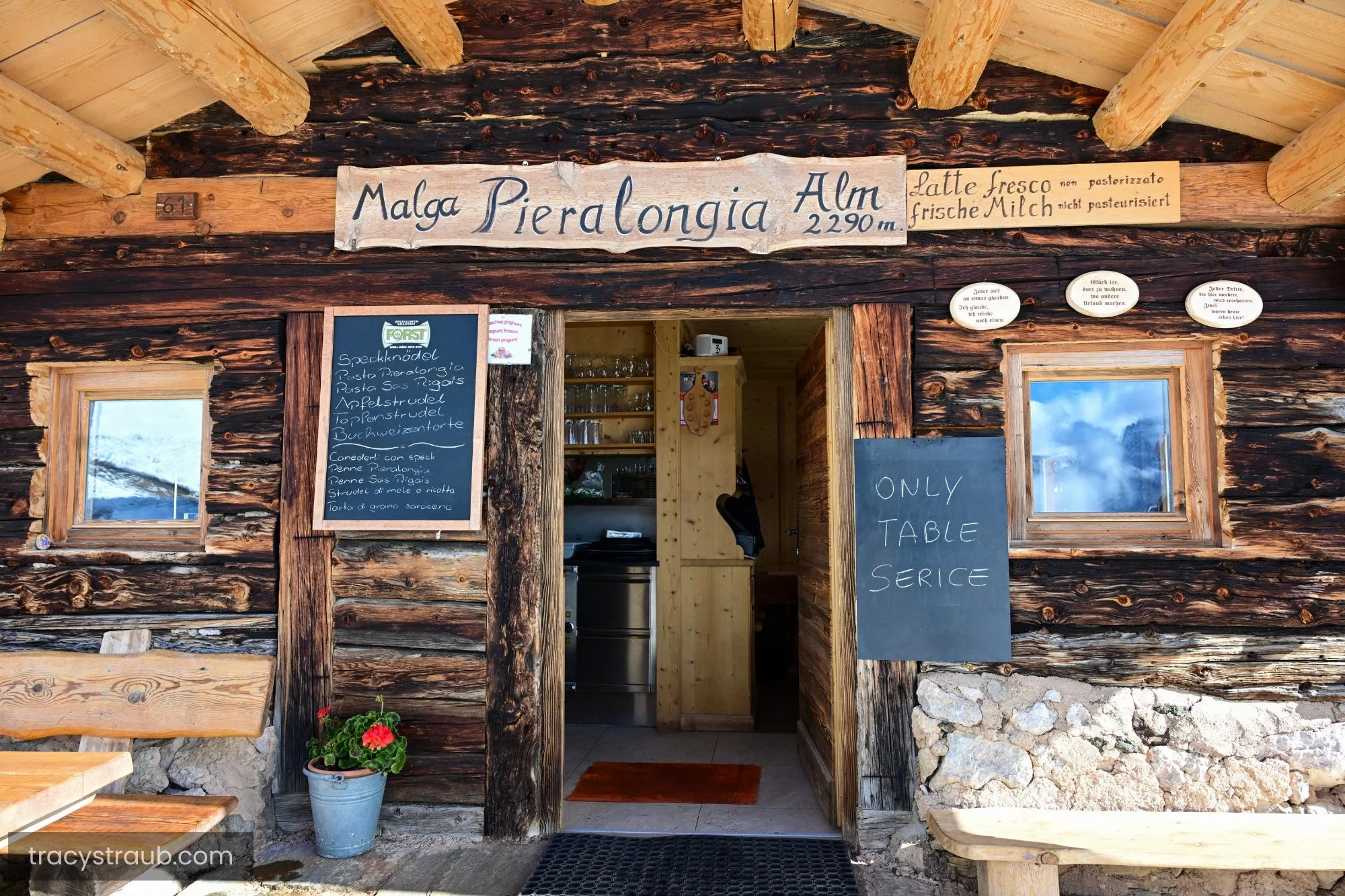
Malga Pieralongia Alm-Schwaige in St. Christina – Val Gardena (South Tyrol), Italy
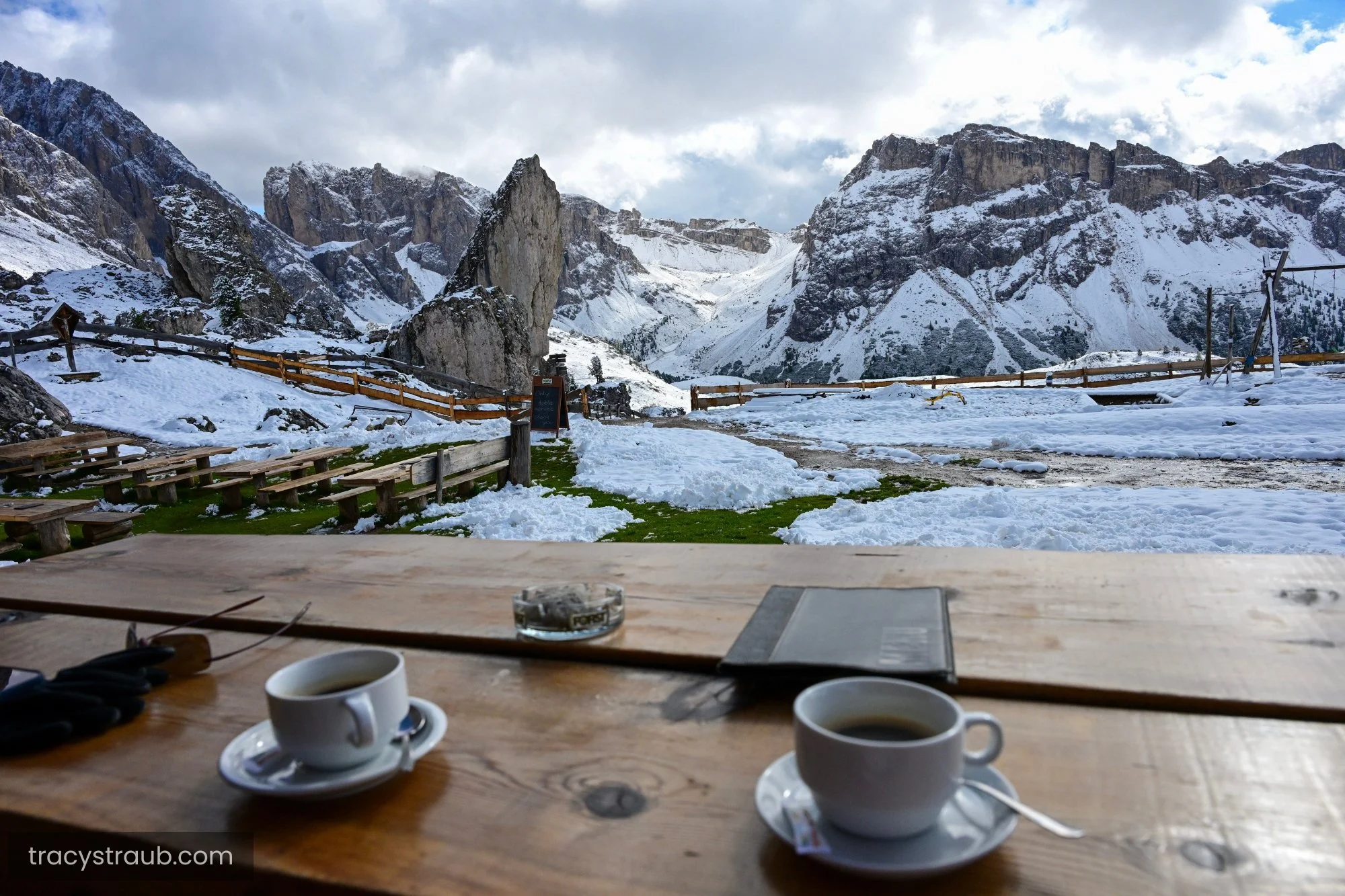
View from our table at Malga Pieralongia Alm-Schwaige in St. Christina – Val Gardena (South Tyrol), Italy
We enjoyed tasse kaffee, bread, cheese, and speck, a dry-cured, lightly smoked ham from South Tyrol. We shared the space (and our snacks) with a handful of other hikers, including a young Polish couple living in Germany. It was one of those rare travel moments where conversation, coffee, and scenery all aligned perfectly.
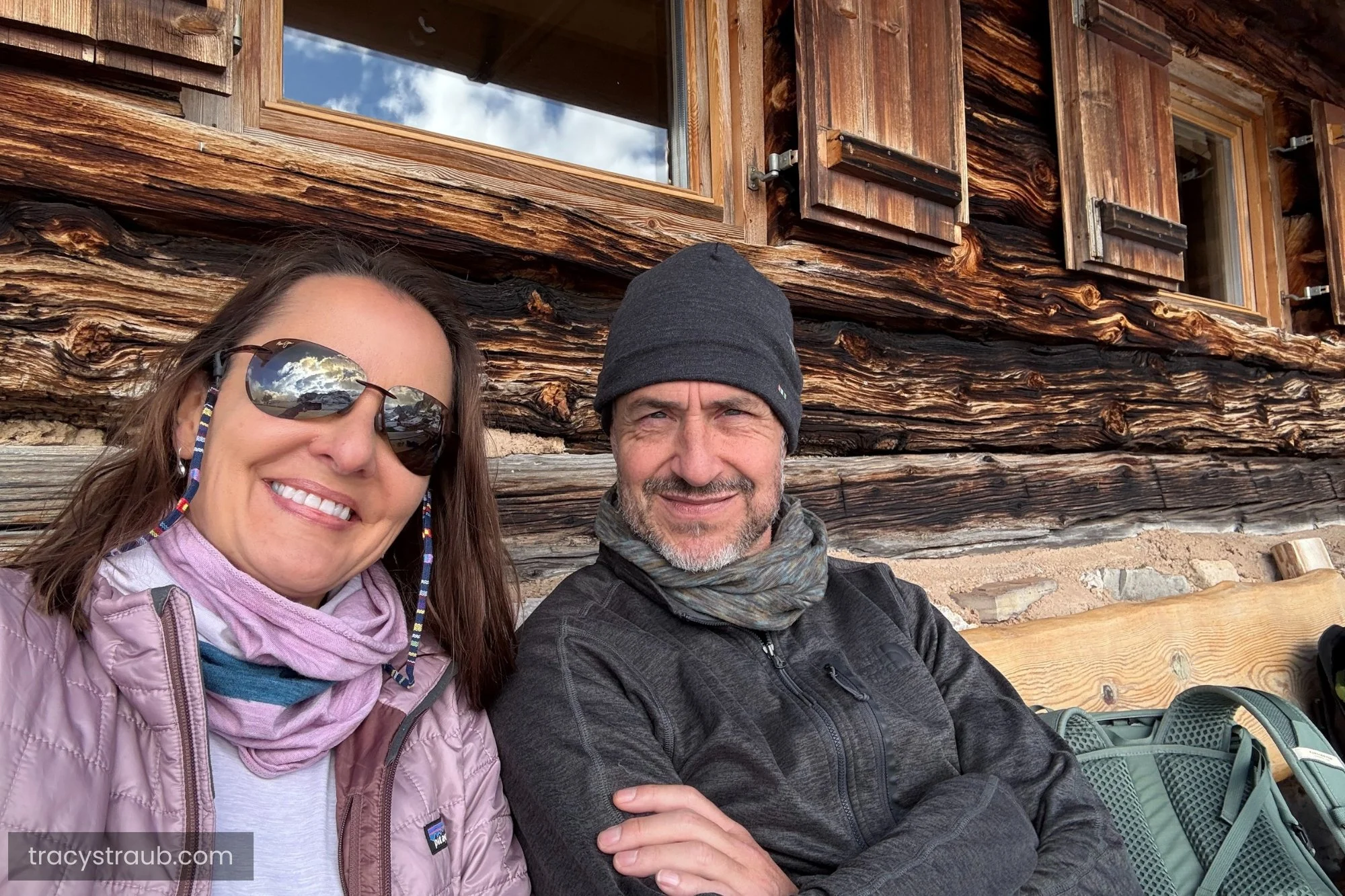
Malga Pieralongia Alm-Schwaige in St. Christina – Val Gardena (South Tyrol), Italy

An Alpaca grazing near a mountain farm on the Seceda ridgeline, Ortisei, Val Gardena, South Tyrol, Italy.
After lunch, we continued hiking along the ridge for about an hour before descending via the Seceda lift back into Ortisei. From there, we walked across town and boarded the Mont Sëuc Lift, which carried us up to Alpe di Siusi (Seiser Alm), the largest high-altitude alpine meadow in Europe.
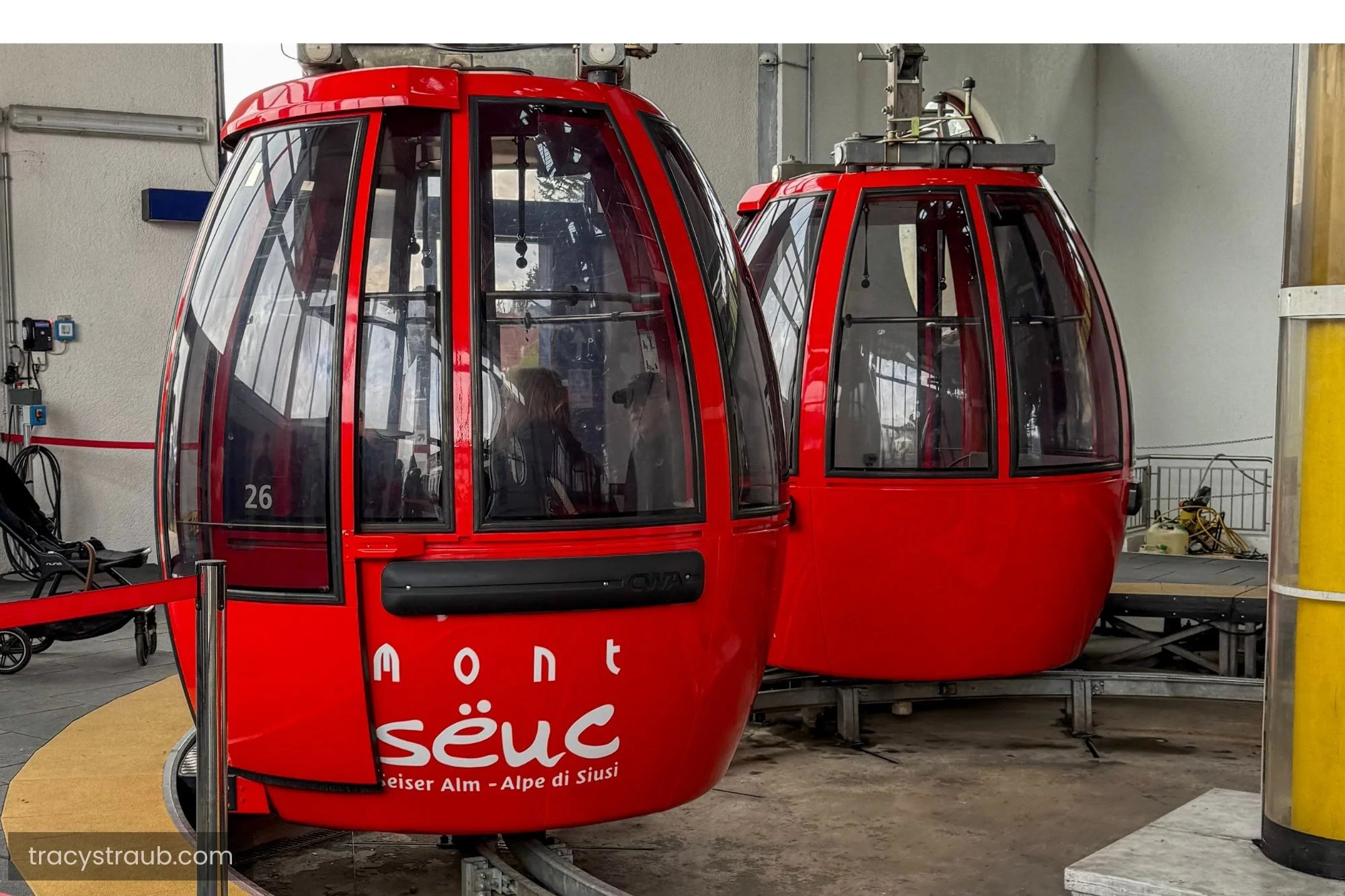
Mont Sëuc Lift in Ortisei, Val Gardena, South Tyrol, Italy — the gateway to Alpe di Siusi, Europe’s largest high-altitude alpine meadow.
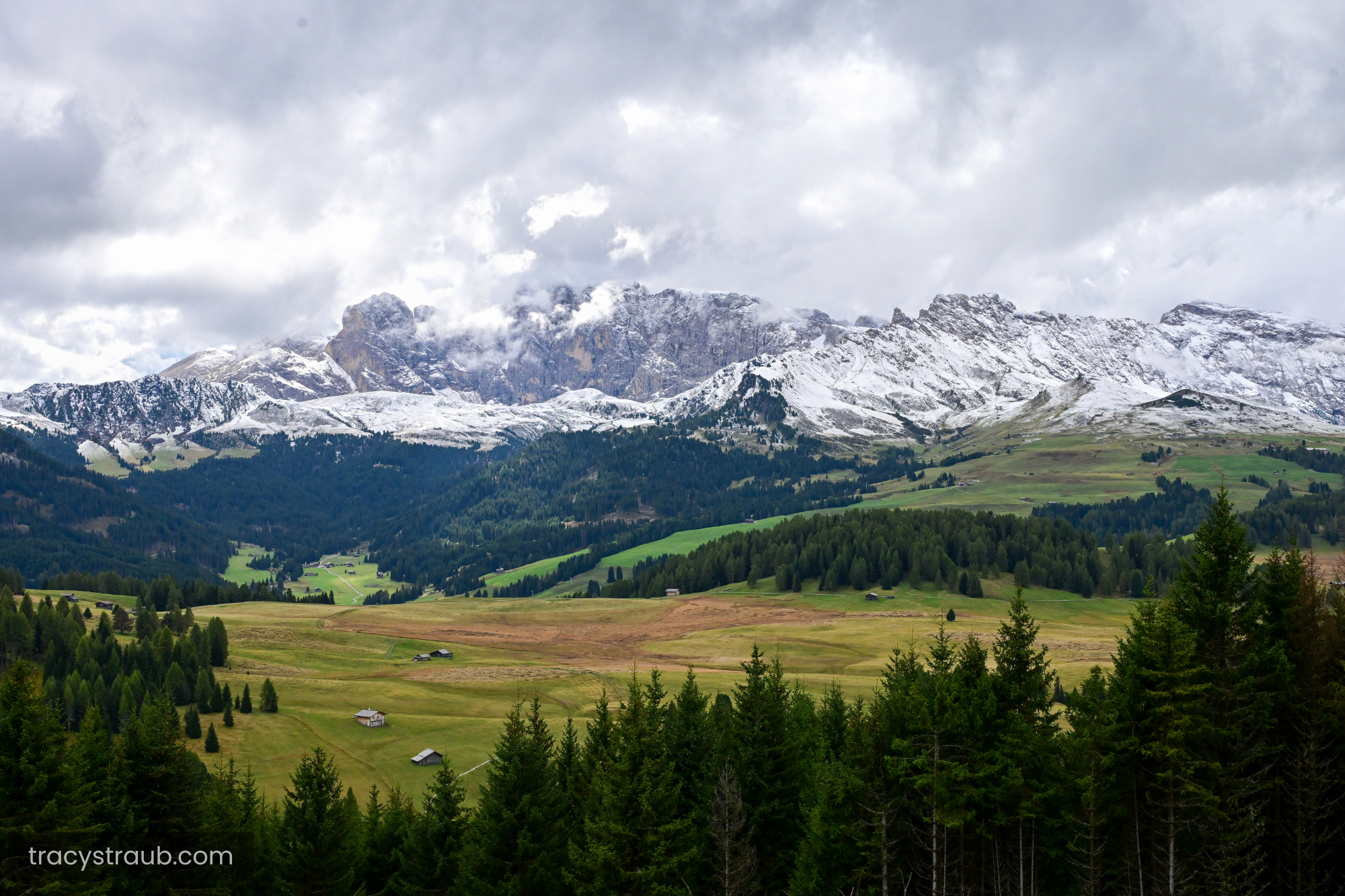
Rolling meadows of Alpe di Siusi in Val Gardena, South Tyrol, Italy.
Stretching across nearly 23 square miles, this vast plateau sits above Val Gardena and offers some of the most recognizable views in the Dolomites. In summer, its rolling pastures are dotted with wildflowers and grazing cows. In autumn, the fields turn golden beneath the sharp limestone peaks of Sassolungo and Sciliar.
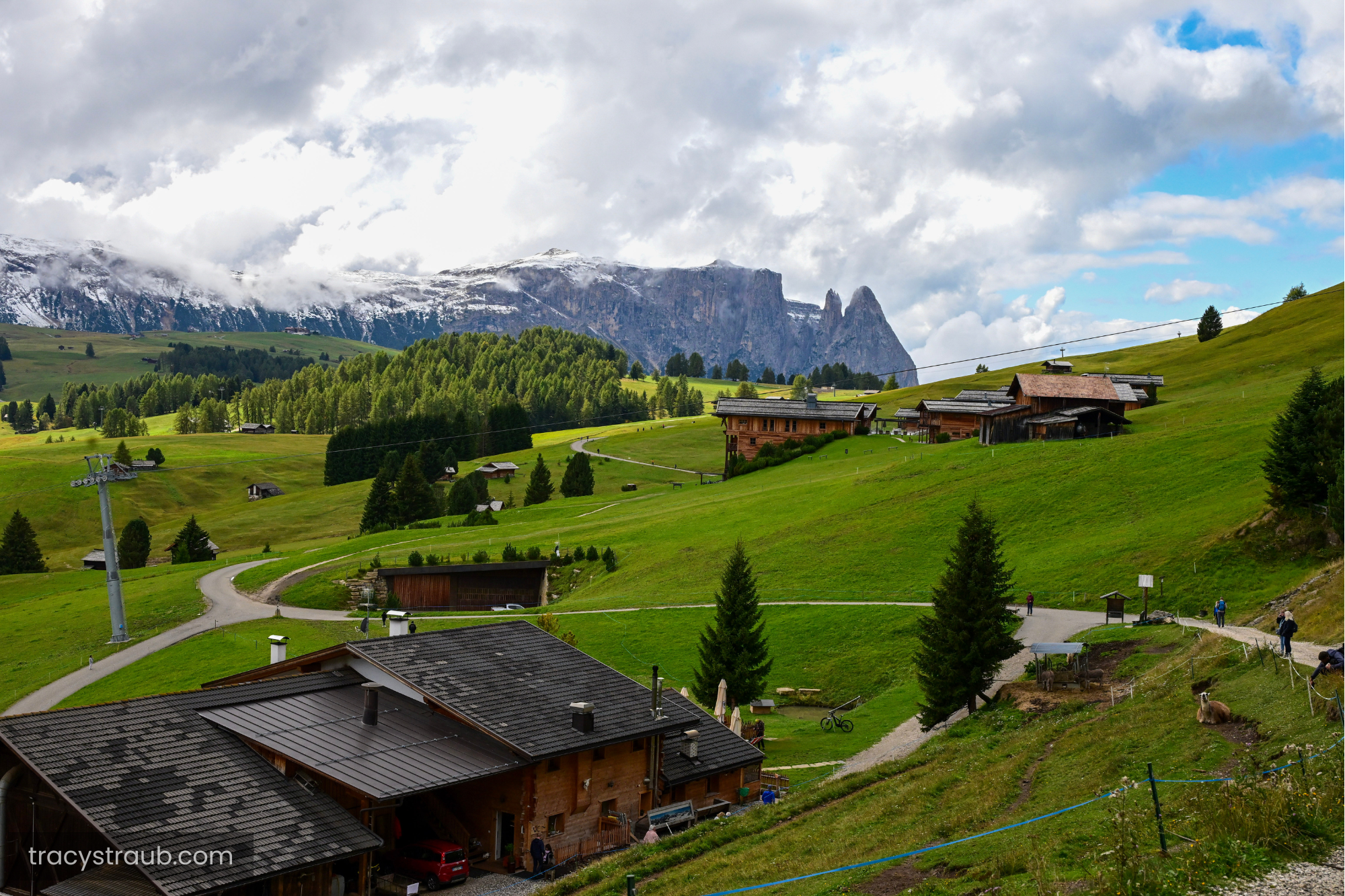
Rolling meadows of Alpe di Siusi in Val Gardena, South Tyrol, Italy.
The contrast between the snow-covered ridgeline that morning and the sunlit meadows of Alpe di Siusi that afternoon was breathtaking, two worlds in a single day.
Back at our Airbnb in Santa Cristina, we opened a bottle of local red wine on the balcony before heading next door for another excellent dinner at L Fudlè.
🥾 Travel Notes: Seceda & Alpe di Siusi
Starting Point: Ortisei, about 10 minutes by car from Santa Cristina
Parking: Multi-level garage beside the Seceda cable car station (paid)
Lifts Used:
Ortisei–Furnes–Seceda Cable Car (round trip)
Mont Sëuc Lift from Ortisei to Alpe di Siusi
Pass Option: Dolomiti Supersummer 5 Giorni su 7 Pass, valid for five lift-access days within seven days, available online at dolomitisuperski.com
Hike Stats (Seceda):
Distance: about 4 miles (6.5 km) round trip from top station along the ridgeline and back
Elevation Gain: about 800 ft (250 m)
Duration: 2 to 3 hours depending on pace and photo stops
Difficulty: Moderate, suitable for most hikers with good footwear
Rifugio Stop: Malga Pieralongia Alm-Schwaige, open seasonally, serves traditional South Tyrolean dishes, coffee, and house-made desserts
Best Time to Go: Morning for clear light on the Odle peaks; early autumn often brings light snow at higher elevations
Alpe di Siusi Tips:
The Mont Sëuc Lift typically runs until late afternoon; check seasonal hours before visiting
Cars are restricted on the Alpe di Siusi plateau from 9 a.m. to 5 p.m. unless staying overnight
Ideal for an easy afternoon walk or e-bike ride with panoramic views
What to Bring: Layers, hiking boots, water, and camera
Day 7: Exploring the Friedrich August Trail, Sella Pass & Lago di Carezza, Dolomites
The next morning, we set out early for the Friedrich August Trail at Sella Pass, one of the Dolomites’ most beautiful ridge hikes. The 25-minute drive from Santa Cristina wound through mountain passes, each turn revealing grander views of the peaks ahead.
We parked near the trailhead at Passo Sella and started our hike along the ridgeline, passing between wide meadows and rocky overlooks with the Sassolungo massif rising dramatically above us. The trail connects several charming mountain huts, each with its own view and alpine character.
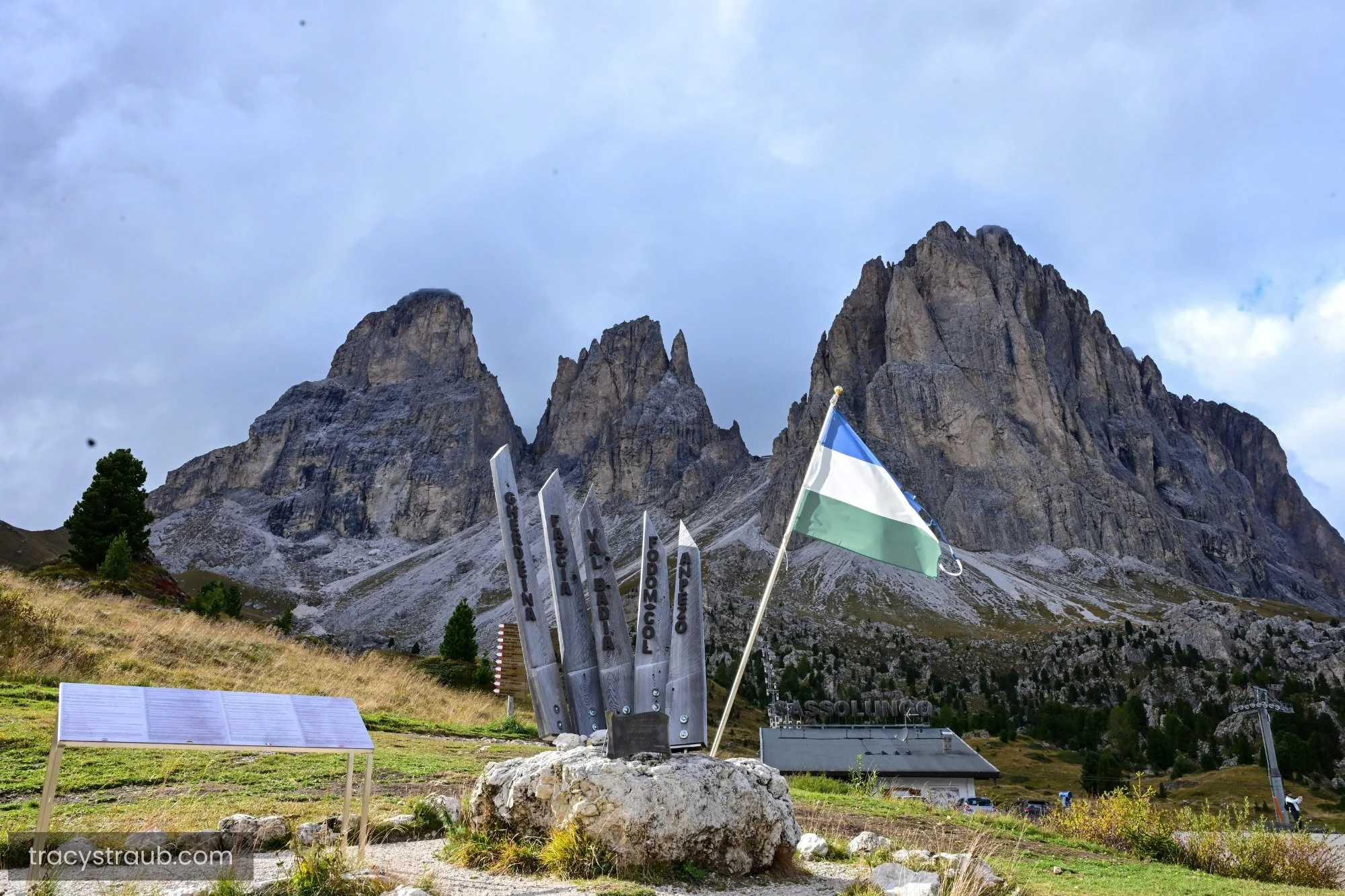
Passo Sella
Our first stop was Friedrich August Refugio, affectionately known by hikers as The Yak Place.
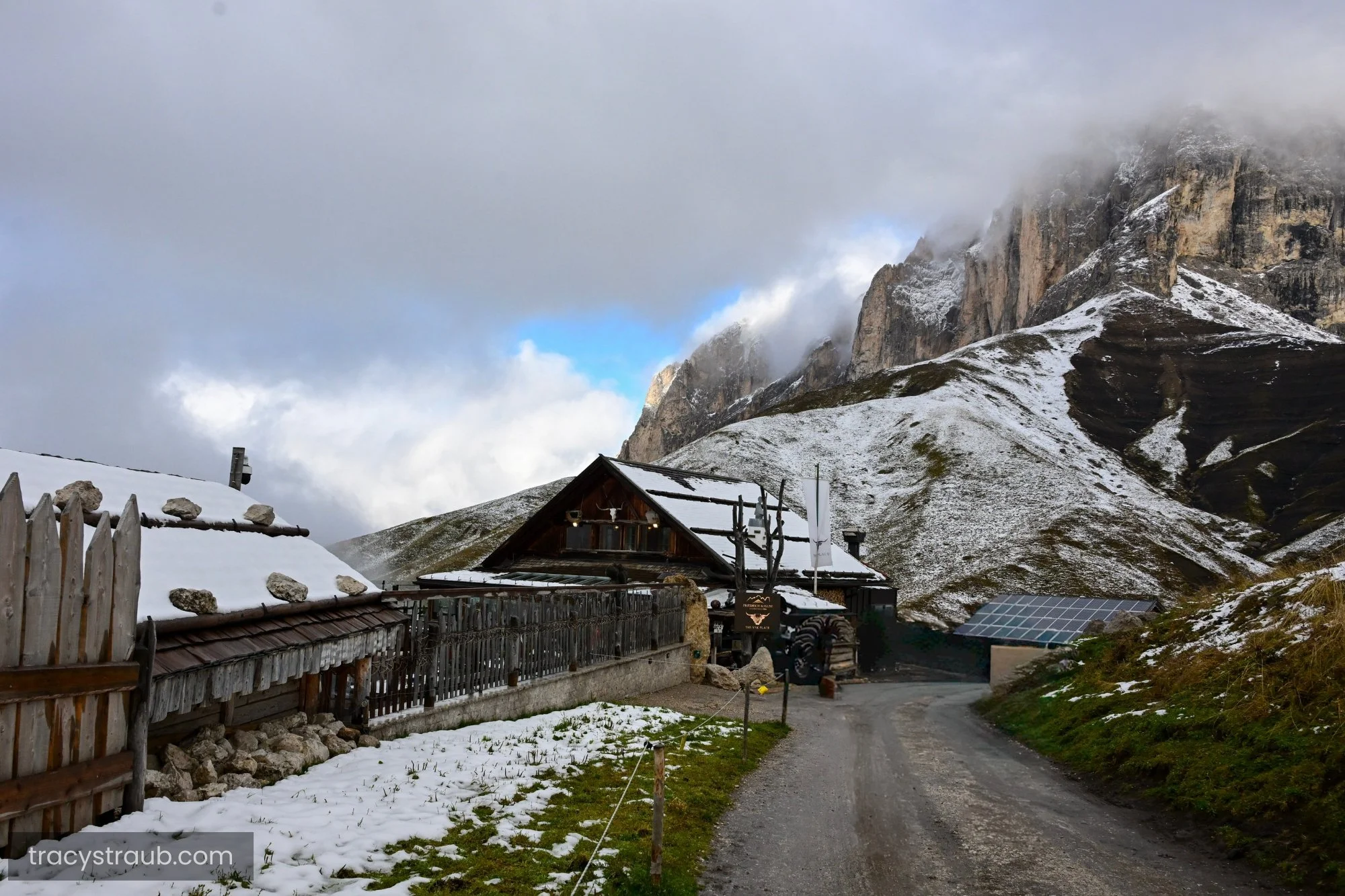
Rifugio Friedrich August, Località Col Rodella, Passo Sella, Canazei, 38031 Campitello di Fassa TN, Italy
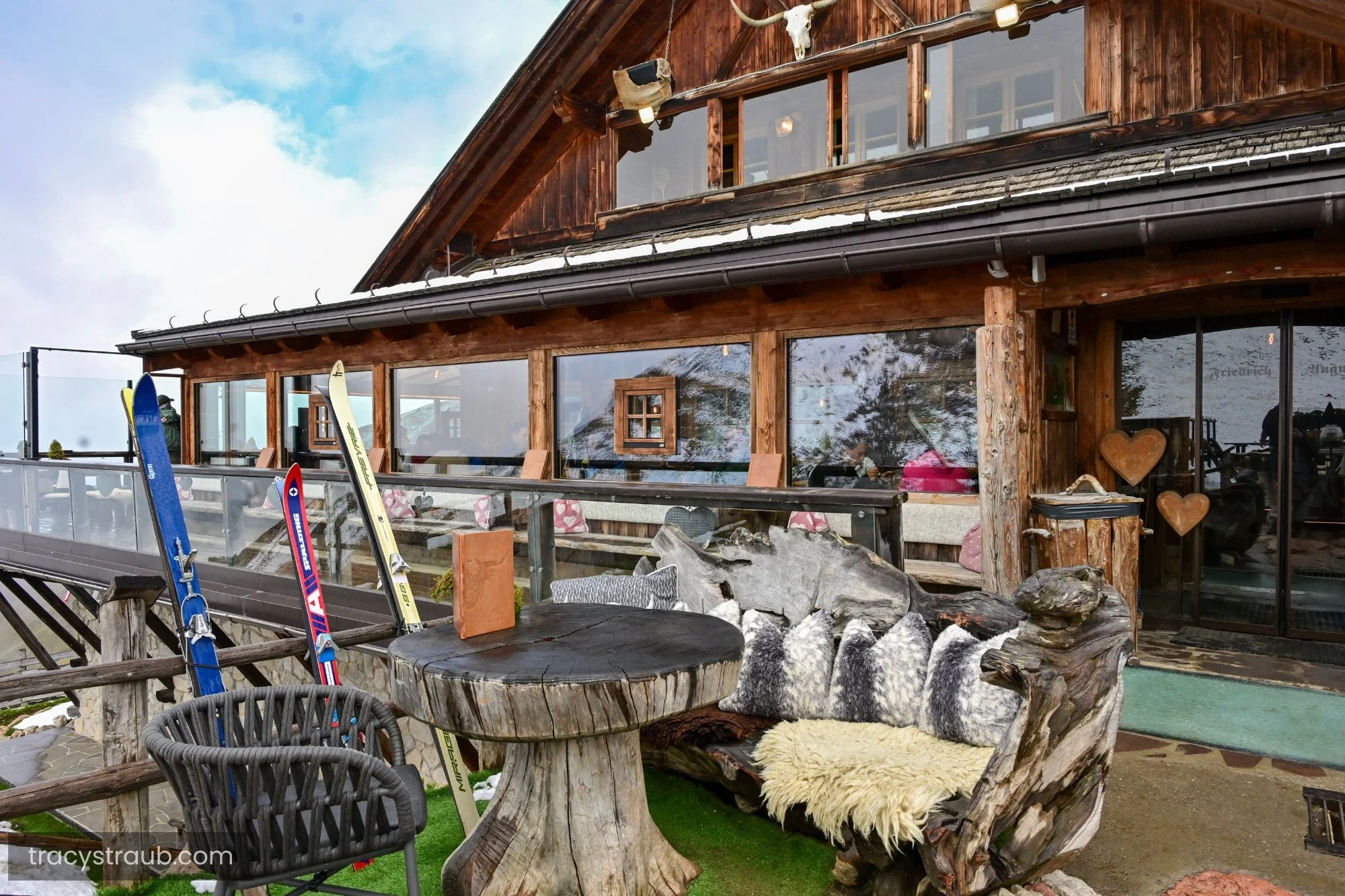
Friedrich August Mountain Hut, Col Rodella area, Sella Pass, Canazei, 38031 Campitello di Fassa, Trentino, Italy
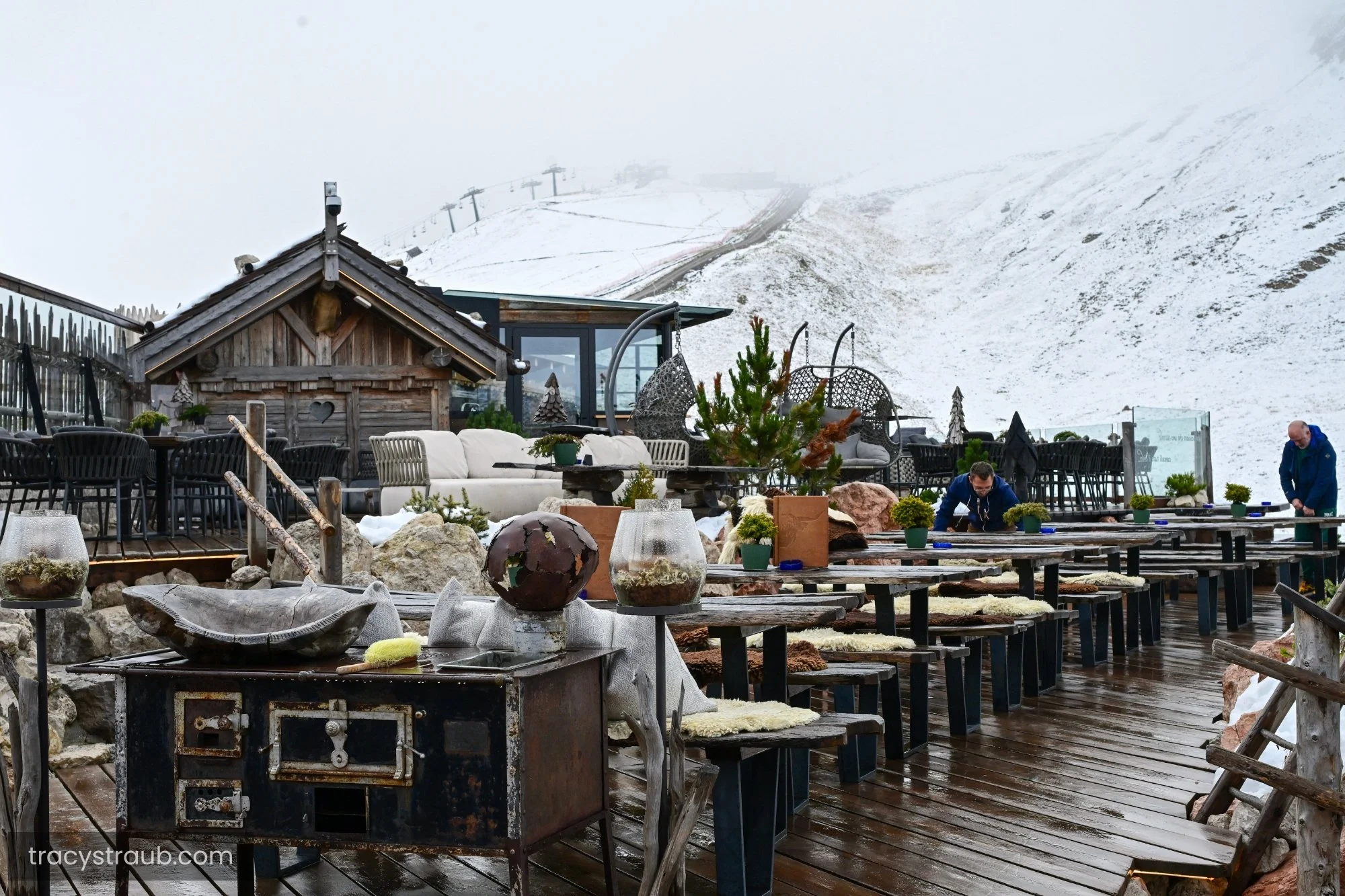
Friedrich August Mountain Hut, Col Rodella area, Sella Pass, Canazei, 38031 Campitello di Fassa, Trentino, Italy
The warmth inside was immediate. Wooden tables, alpine décor, and the smell of fresh pastries and espresso filled the air. We were seated at a sunlit table by the window and took our time savoring both the food and the view. As we enjoyed our coffee, light snow began to fall outside, softening the landscape and adding to the quiet magic of the morning. It felt like stepping into a storybook, and I cannot recommend it enough.
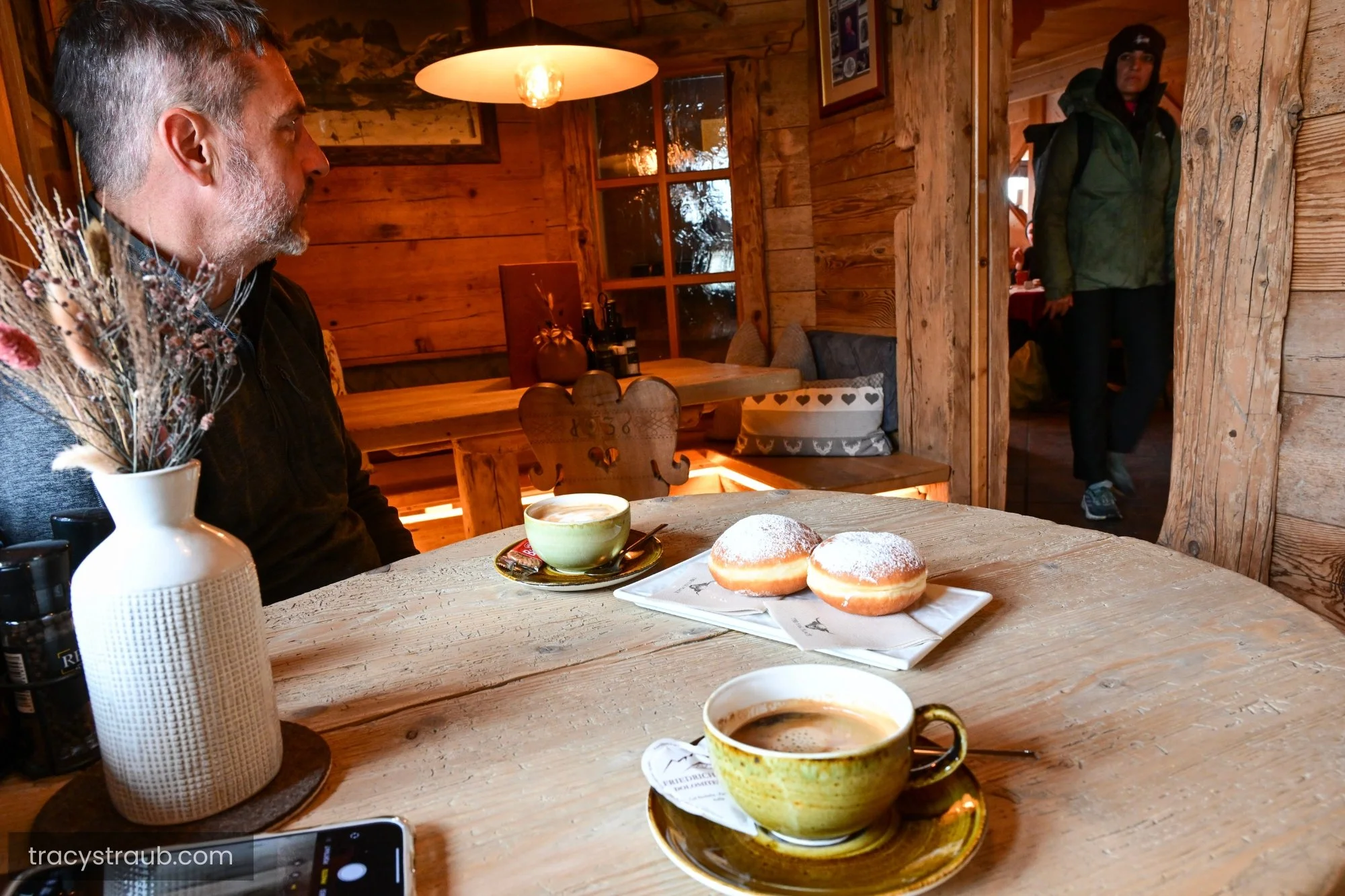
Friedrich August Mountain Hut, Col Rodella area, Sella Pass, Canazei, 38031 Campitello di Fassa, Trentino, Italy
After our coffee and donuts, we continued our hike toward the base of the Forcella Sassolungo lift, a unique cable car often called the coffin lift because of its small, upright, two-person cabins.
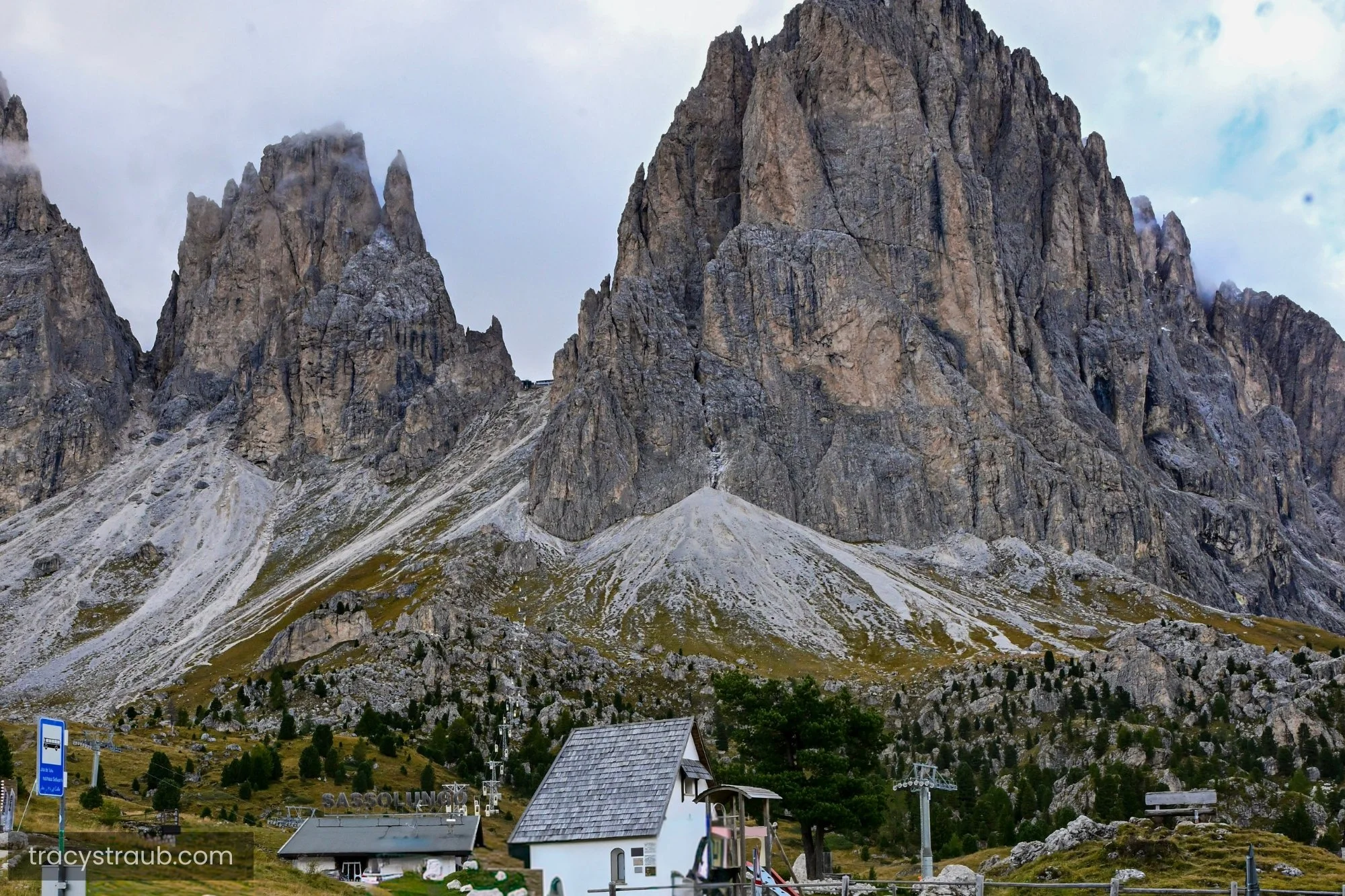
Forcella Sassolungo lift at Passo Sella, Val Gardena, South Tyrol, Italy.
The lift never stops, so riders have to hop on and off while it is still moving, which adds to the thrill. It travels from Passo Sella up to Forcella Sassolungo, a high mountain saddle beneath the towering Sassolungo peak, and serves as a popular starting point for alpine hikes with sweeping views across the Dolomites.

Forcella Sassolungo lift at Passo Sella, Val Gardena, South Tyrol, Italy
That September day was cold and windy, with patches of ice clinging to the rocks near the top. Still, the views were stunning. From the summit, we could see the jagged Dolomite peaks stretching endlessly in every direction, clouds sweeping dramatically across the ridgeline.
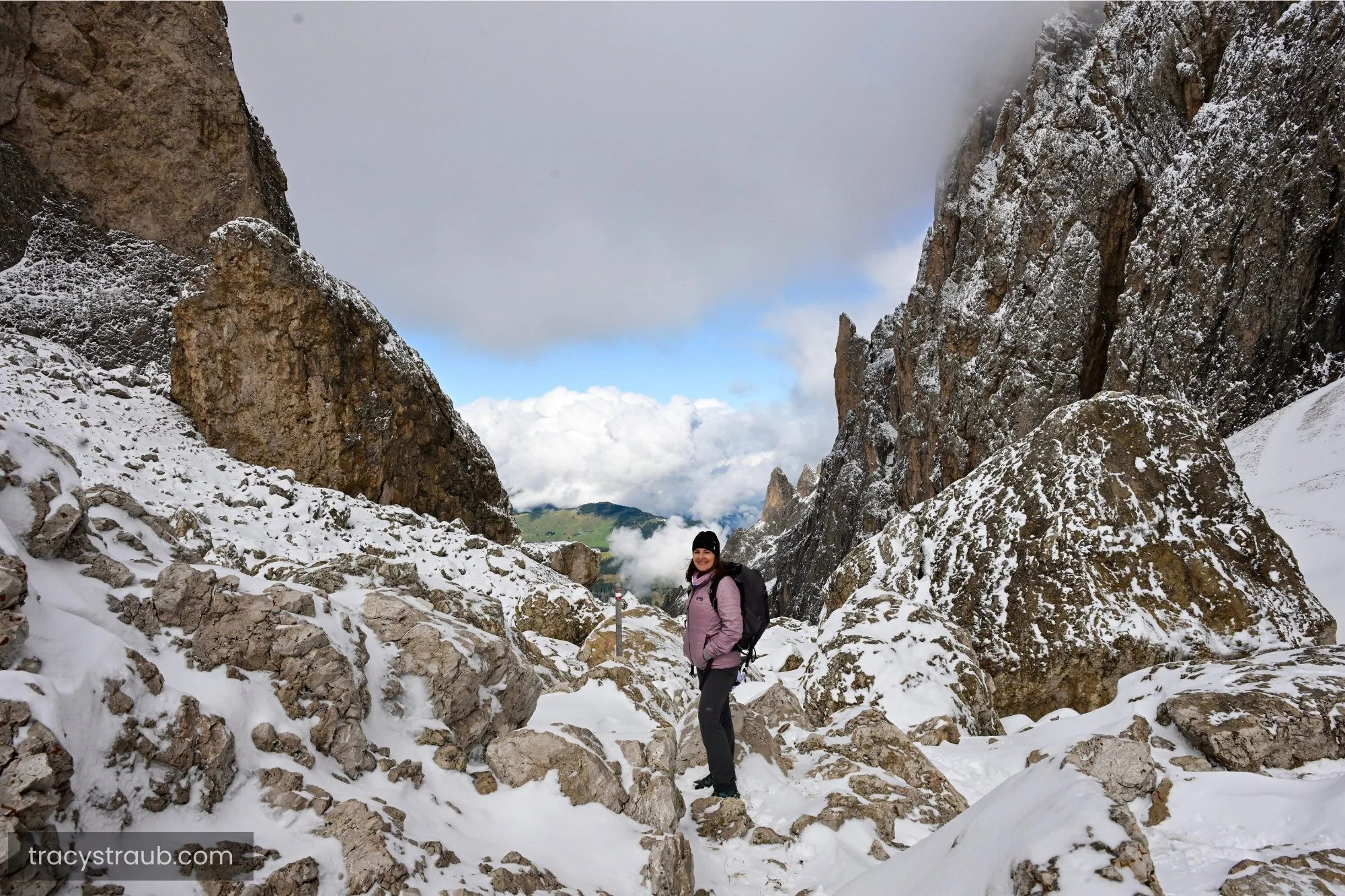
Forcella Sassolungo at Passo Sella, Val Gardena, South Tyrol, Italy
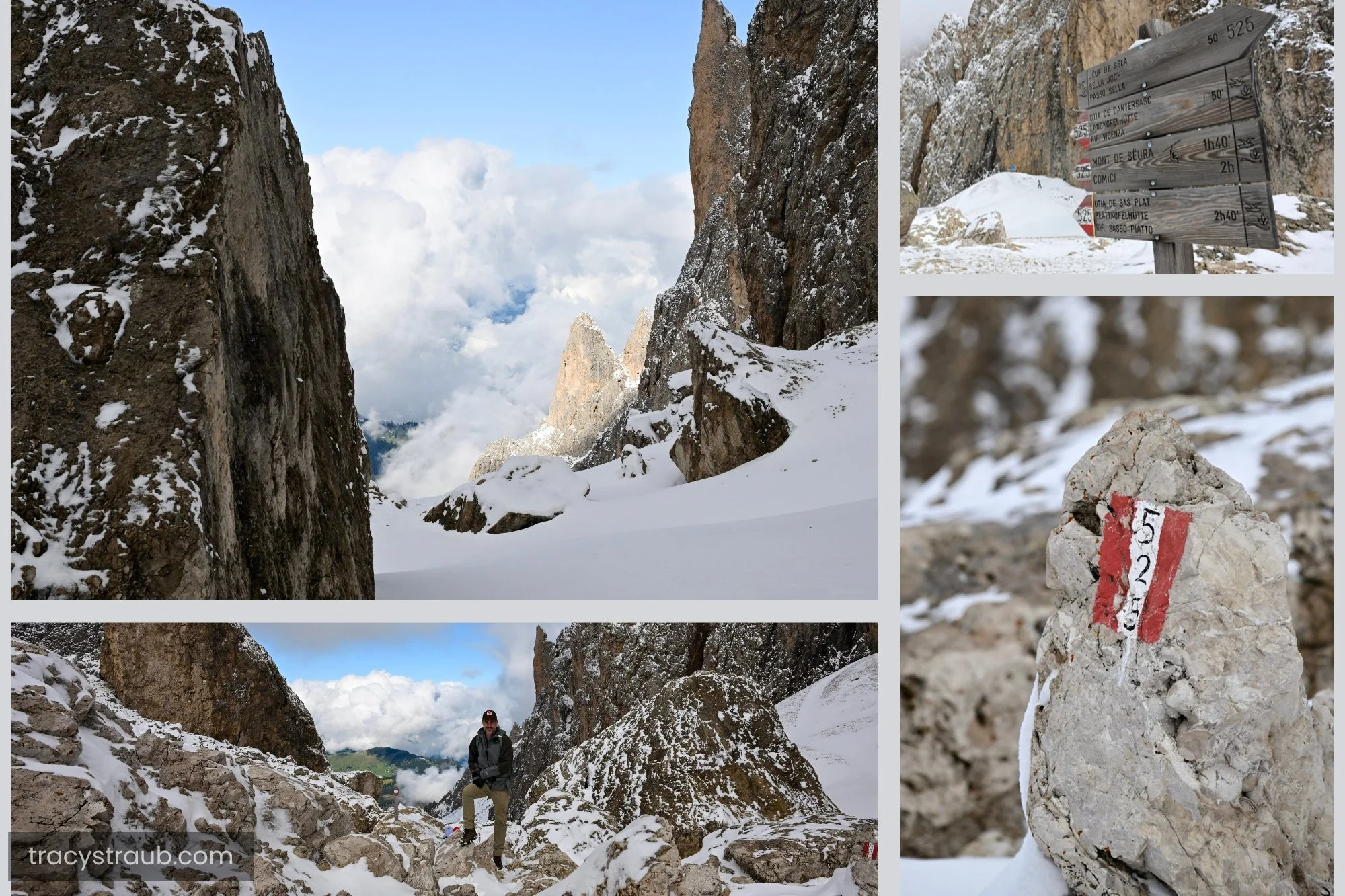
Forcella Sassolungo lift at Passo Sella, Val Gardena, South Tyrol, Italy
We stayed about forty-five minutes, taking in the rugged beauty and vast mountain vistas, before hopping back into the moving lift to descend and end our hike.
In the afternoon, we drove to Lago di Carezza (Karersee), where the emerald-green water shimmered under the late-day sun. This was one of the more crowded stops of our trip, especially compared to the quiet alpine trails, but the view was worth it.
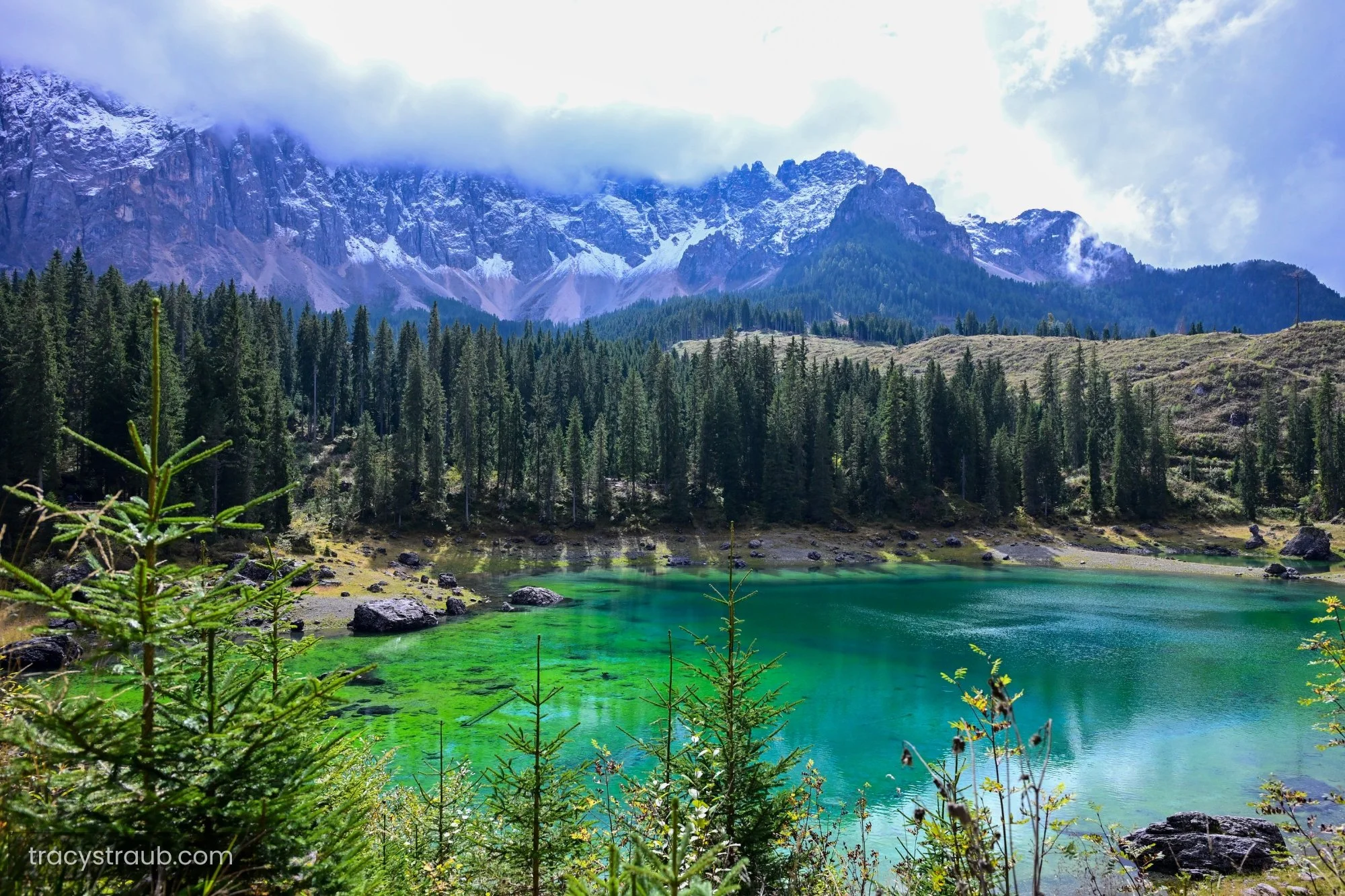
Lago di Carezza (Karersee), 39056 Nova Levante, South Tyrol, Italy — a stunning alpine lake famous for its emerald-green water and reflections of the Latemar mountains.
A short, well-maintained walking path circles the lake, offering several viewpoints that showcase the mirror-like reflection of the Latemar peaks on the surface.
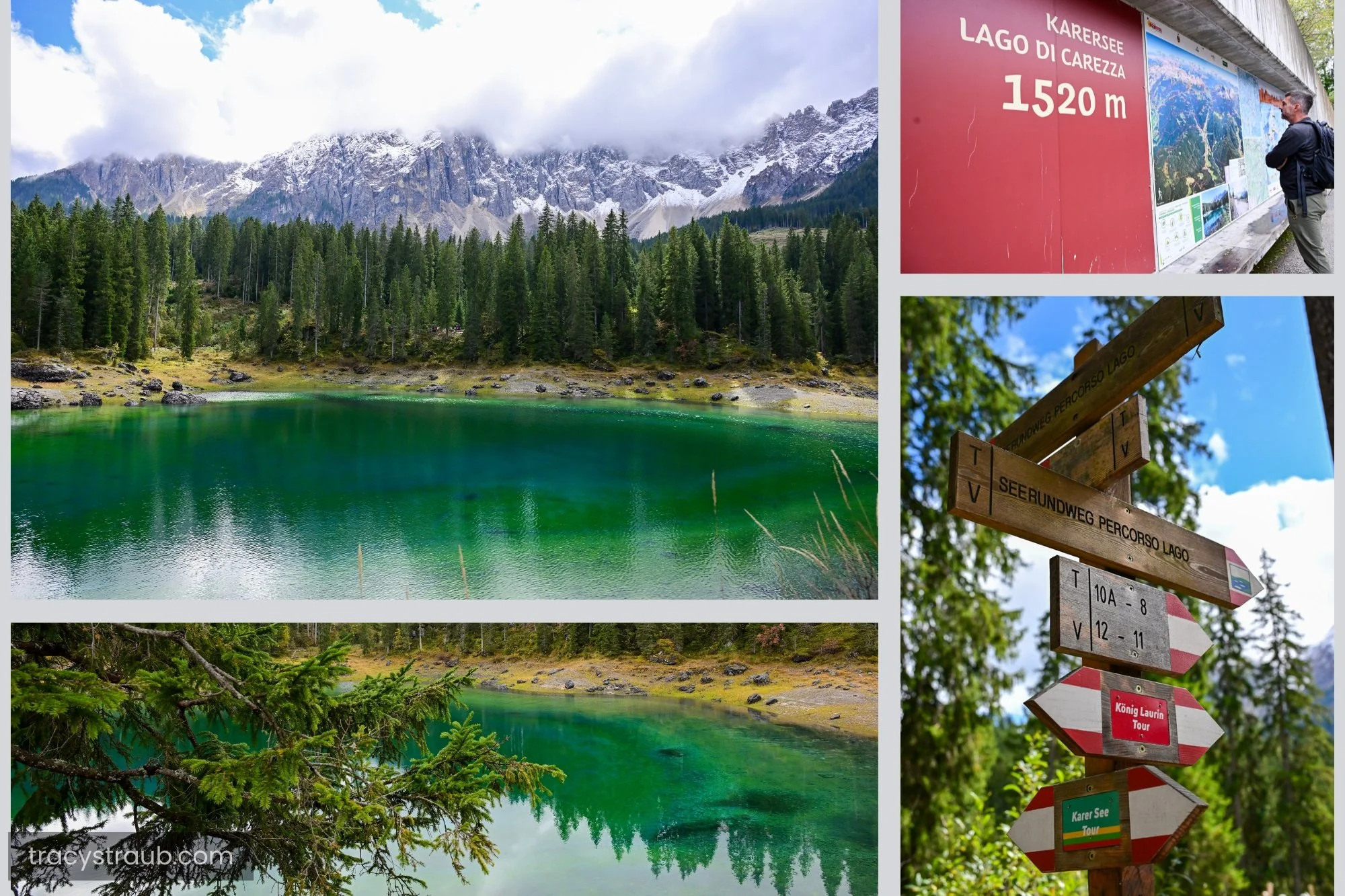
Lago di Carezza (Karersee), 39056 Nova Levante, South Tyrol, Italy.
That evening marked our last night in Santa Cristina. Dinner was at Ristorante La Tambra, a cozy alpine steakhouse that turned out to be one of our favorite meals of the trip. We started with Fonduta al Parmigiano con Uovo Poché e Tartufo, a rich Parmesan fondue topped with a poached egg and shaved truffle, followed by Filetto 100% Alto Adige, a perfectly cooked South Tyrolean beef tenderloin. Every dish was beautifully prepared and full of comforting flavor, paired with a smooth local red wine.
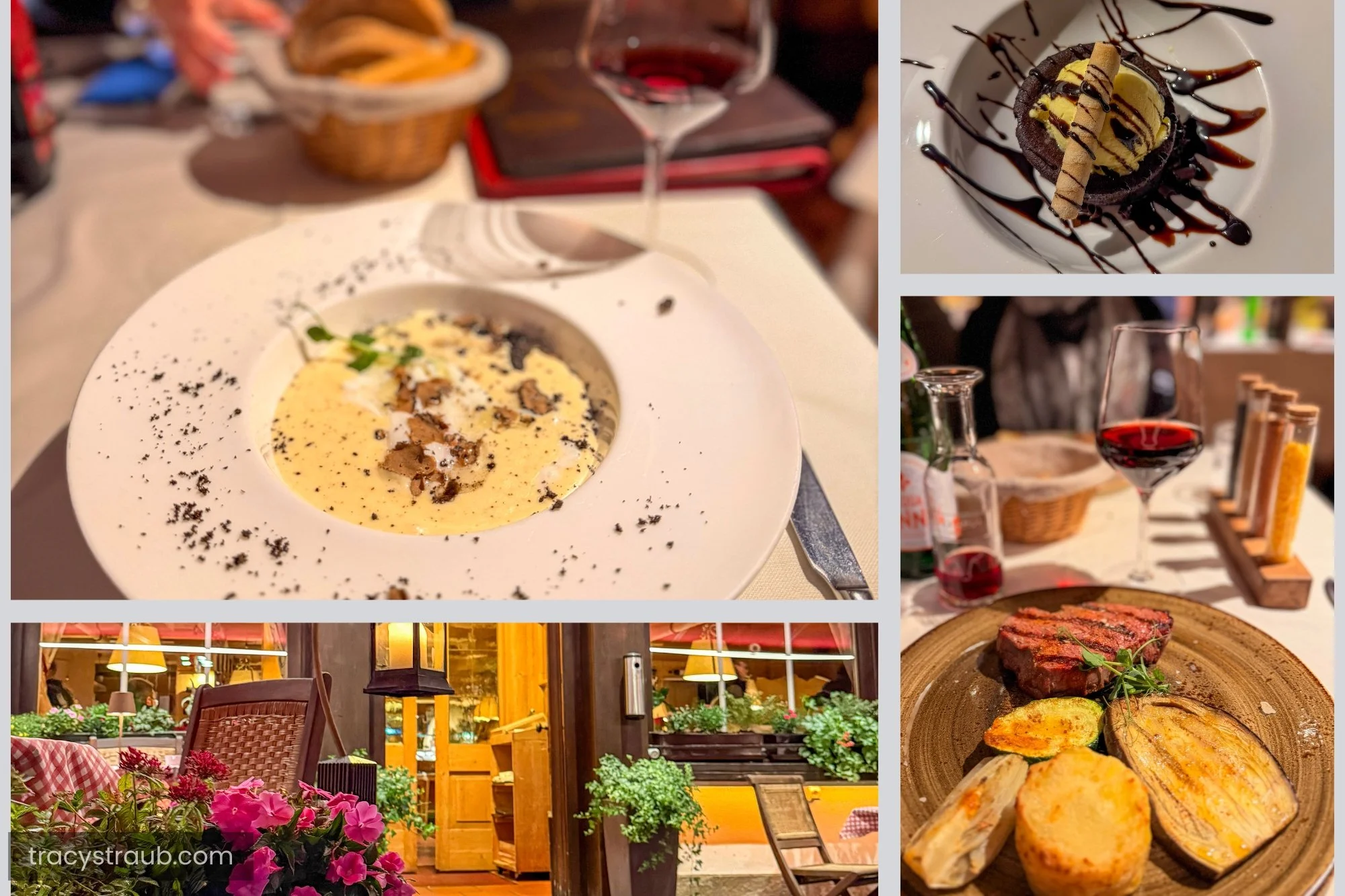
Dinner at Ristorante La Tambra, Str. Dursan 20, 39047 Santa Cristina Valgardena, South Tyrol, Italy
Walking back through the quiet streets afterward, we tried to make the most of our last moments in a town we genuinely enjoyed.
🏞️ Travel Notes: Friedrich August Trail, Sella Pass & Lago di Carezza
Drive Time:
Santa Cristina to Sella Pass: about 25 minutes
Sella Pass to Lago di Carezza: about 1 hour 20 minutes
Parking: Paid lots near the Rifugio Passo Sella trailhead and Lago di Carezza Visitor Center. Machines accept cash or cards.
Trail Info (Friedrich August):
Starting Point: Passo Sella (2,240 m elevation)
Distance: about 6 miles (9.5 km) round trip, depending on route
Duration: 3 to 4 hours
Difficulty: Moderate, with rolling terrain and well-marked trails
Highlights: Sassolungo views, multiple rifugios along the way, including Friedrich August Refugio
Trail Signage: Trails are clearly marked with red-and-white CAI signs showing route numbers and distances between huts.
Weather Note: In early autumn, light snow or frost is common above 2,000 meters. Bring layers, gloves, and a hat even on clear mornings.
Small two-person cabins require stepping in and out while moving
Summit altitude: 2,685 m
Lift Access Tip: The Dolomiti Supersummer Pass (the summer version of the Dolomiti Superski Pass) is accepted on this lift and many others throughout the Val Gardena, Sella, and Alpe di Siusi areas. If you plan to take multiple lifts during your trip, this pass can offer significant savings and added flexibility.
Lago di Carezza Tips:
Entrance: Free, parking €2 per hour
Walking Path: 20 to 30 minutes around the lake, flat and accessible
Best Time to Visit: Morning or late afternoon for fewer crowds and optimal reflections
Bathrooms (free) and cafés available near the visitor center
Dining:
Ristorante La Tambra, Santa Cristina – traditional alpine steakhouse with excellent service and refined South Tyrolean cuisine
What to Bring: Layers, hiking boots, water, camera, and a sense of adventure for the moving cable car
Day 8: Discovering Val di Funes & Geisler Alm in the Dolomites
We left Santa Cristina early for Val di Funes, one of the most picturesque valleys in the Dolomites and home to two of the most photographed churches in Italy. The drive took about an hour and fifteen minutes, winding through alpine passes that grew more dramatic with every turn.
We parked near the Santa Maddalena Church, where there is a small self-pay lot that fits around a dozen cars. Arriving early is essential, both for parking and for capturing photos in the soft morning light.
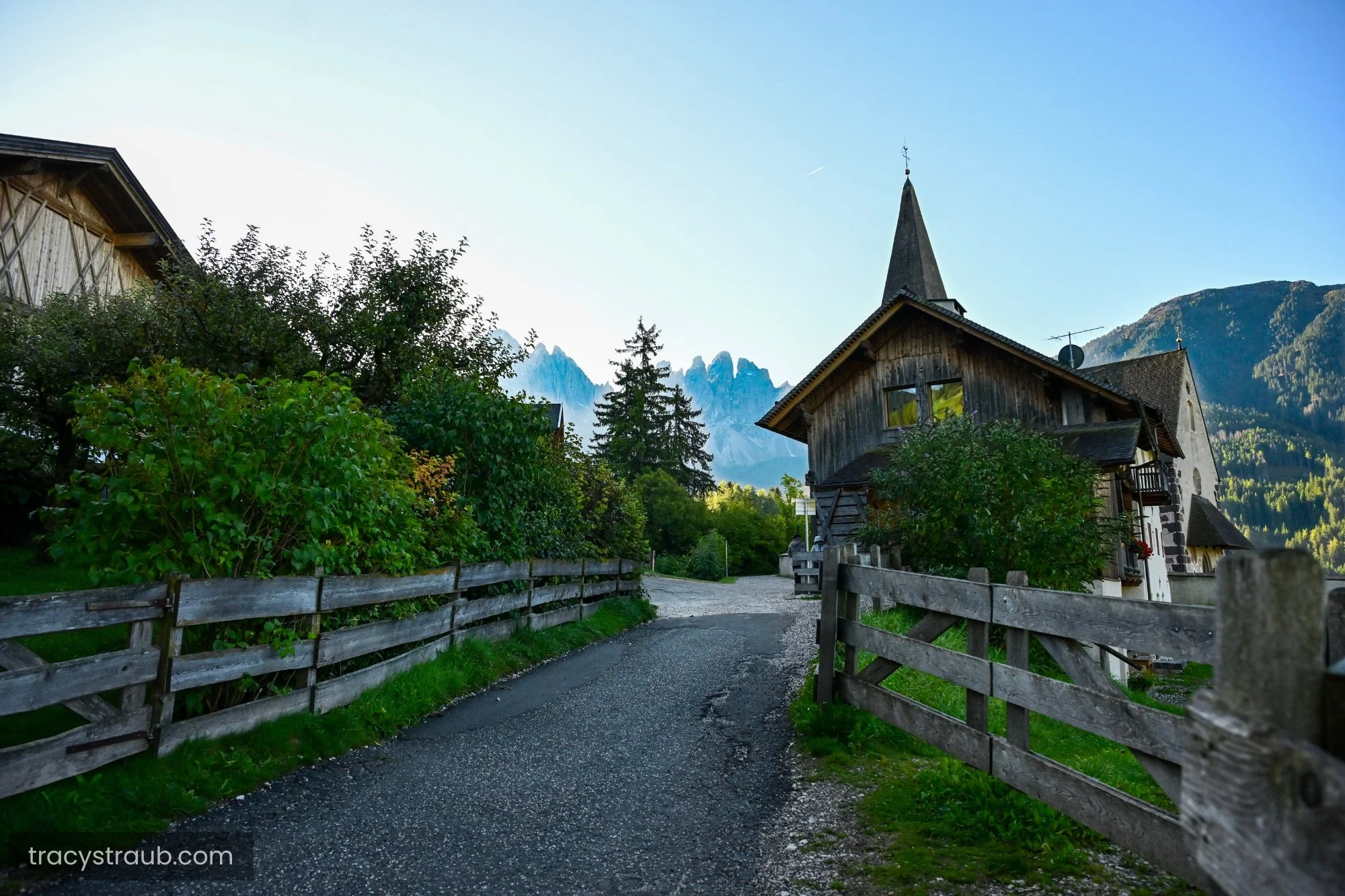
Hiking up to Santa Maddalena Church (Chiesa di Santa Maddalena), Via Santa Maddalena, 39040 Funes (Villnöss), South Tyrol, Italy
After 9:30 a.m., the sun moves directly beside the church, making it difficult to photograph without glare or harsh shadows. If you miss that early golden light, plan to return in the late afternoon/evening when the sun shifts and illuminates the village and peaks beautifully from the west.

Santa Maddalena Church (Chiesa di Santa Maddalena), Via Santa Maddalena, 39040 Funes (Villnöss), South Tyrol, Italy — overlooking the Val di Funes valley with the Odle Peaks in the background.
Our next stop was the Chiesetta di San Giovanni in Ranui, the small white church with its distinctive onion dome that sits quietly at the base of the valley, surrounded by green meadows and towering peaks. It is one of the most photographed landmarks in Val di Funes, and standing there in person feels even more peaceful than the photos suggest.
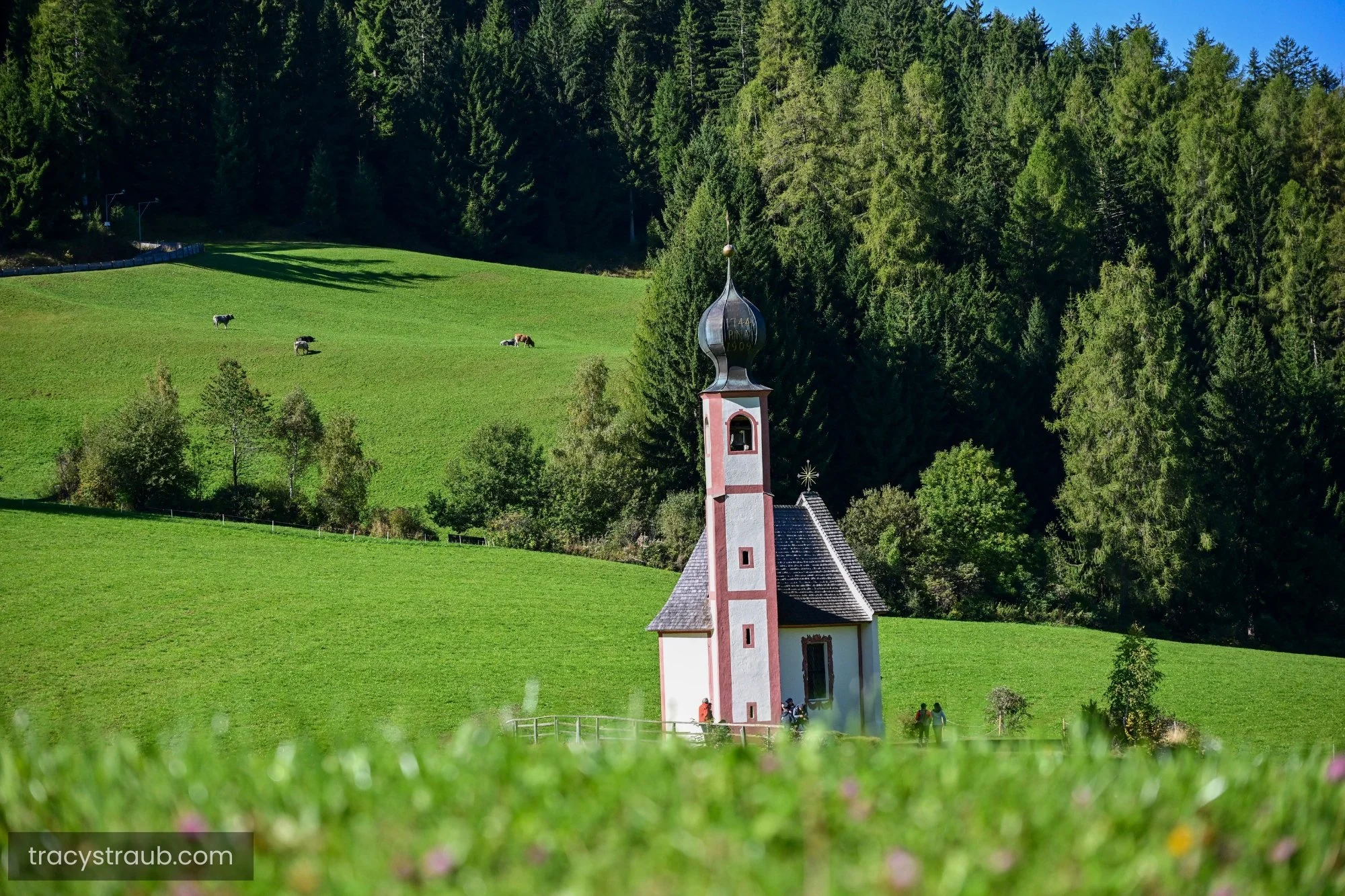
Church of St. John in Ranui (Chiesetta di San Giovanni in Ranui), Ranui Street 5, 39040 Funes (Villnoss), South Tyrol, Italy

Church of St. John in Ranui (Chiesetta di San Giovanni in Ranui), Ranui Street 5, 39040 Funes (Villnoss), South Tyrol, Italy
From the church, we began our 7.29-mile (11.7 km) hike to Rifugio Odle (Geisler Alm), gaining 2,231 feet (680 m) of elevation and completing the route in about two hours and forty minutes, including breaks for photos and lunch. The trail winds gradually upward through pine forest and open meadows with sweeping views of the Odle Peaks (Geislergruppe).
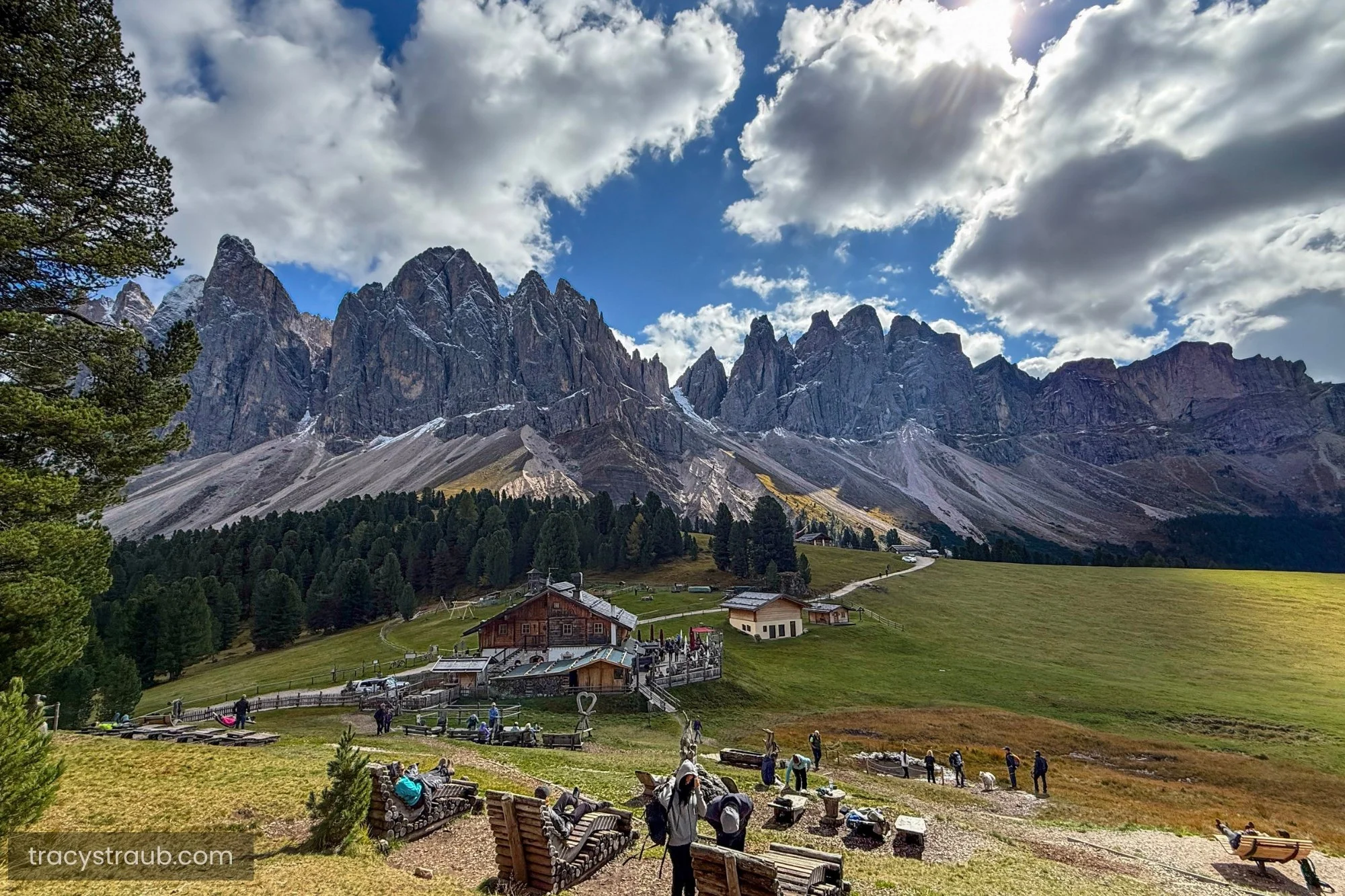
Rifugio Odle (Geisler Alm), Santa Maddalena, 39040 Funes (Villnoss), South Tyrol, Italy
By late morning, we reached Rifugio Odle, perched perfectly beneath the jagged limestone spires. The terrace view alone was worth every step. Service was relaxed, true to alpine pace, and the food was hearty and authentically Tyrolean.
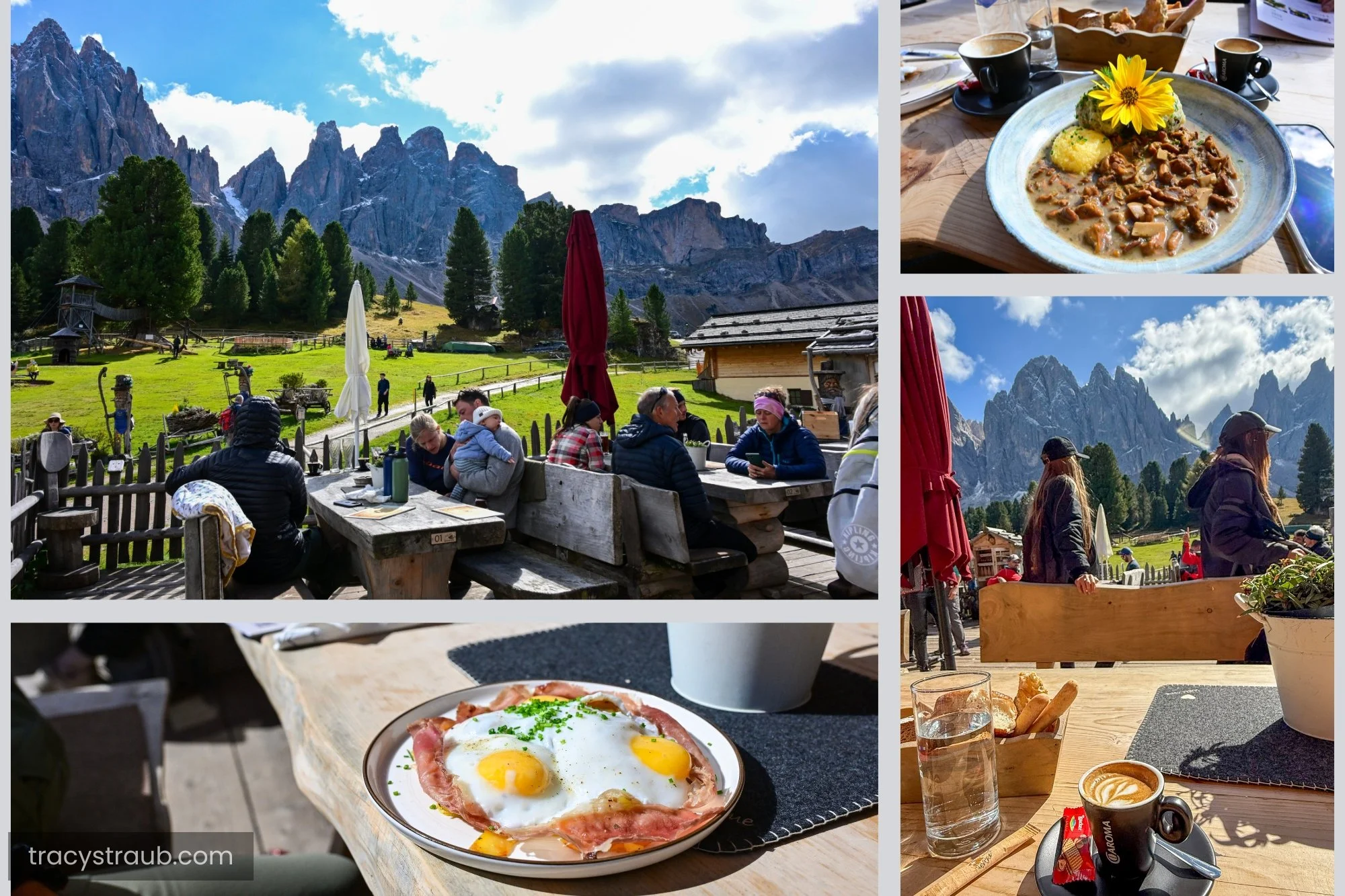
Rifugio Odle (Geisler Alm), Santa Maddalena, 39040 Funes (Villnoss), South Tyrol, Italy
After lunch, we stayed on the terrace a little longer, taking photos and soaking in the stillness of the valley before beginning our descent. The return hike offered sweeping, ever-changing views of the Dolomites.
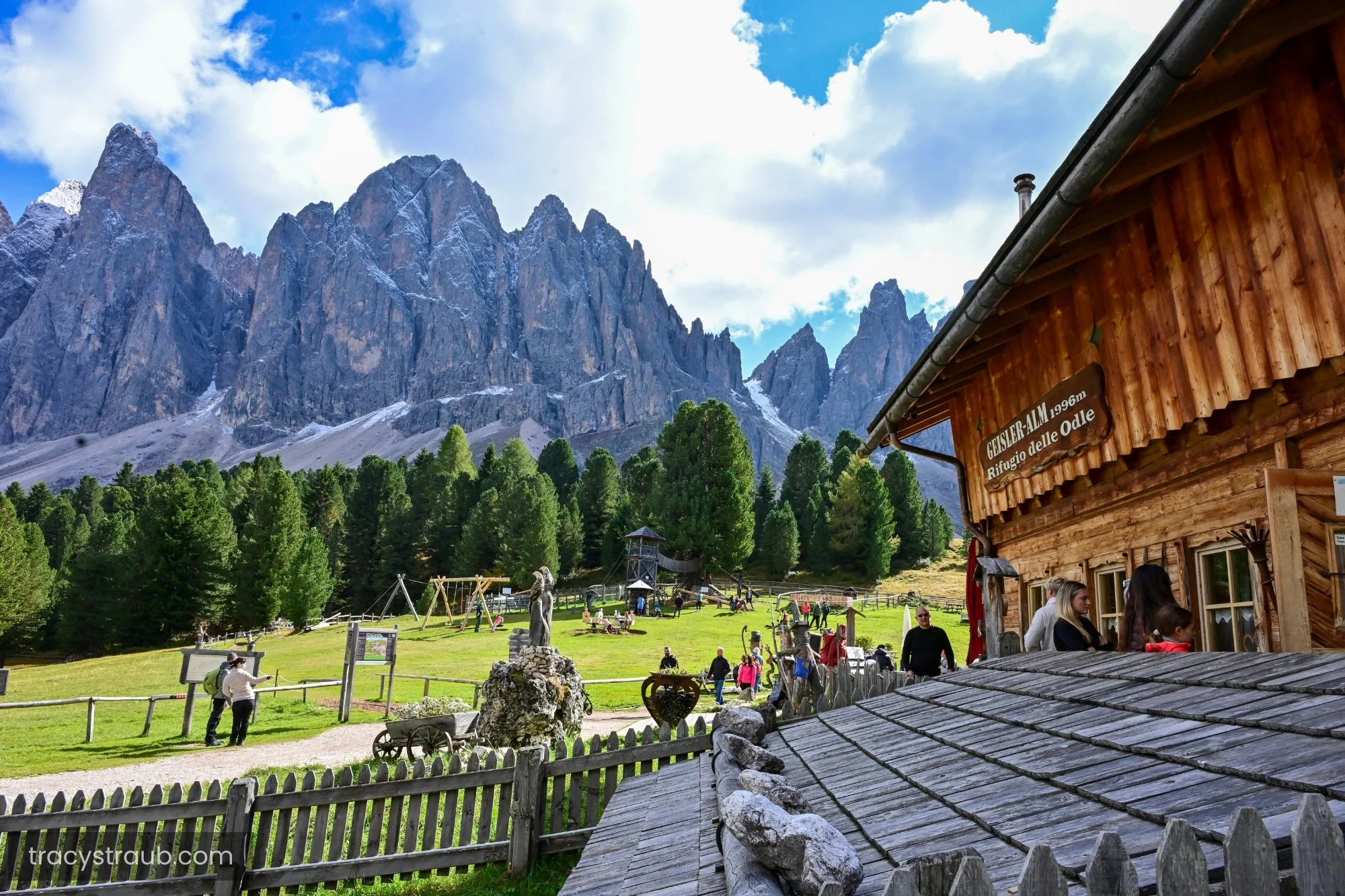
Rifugio Odle (Geisler Alm), Santa Maddalena, 39040 Funes (Villnoss), South Tyrol, Italy
By late afternoon, we were back at our car and began the drive toward Cortina d’Ampezzo, arriving just before evening. We checked into our new Airbnb, where, as with our previous stay, our host greeted us warmly, gave a quick tour, and collected the traveler’s tax of €2.50 per person per night in cash.
Cortina immediately felt different from the quiet mountain villages we had stayed in before. The town was lively and full of energy, with the hum of construction everywhere as it prepared to host the 2026 Winter Olympics. Cranes and scaffolding dotted the skyline, and there was a tangible sense of excitement in the air — a city getting ready to shine on the world stage.
🥾 Travel Notes: Val di Funes & Geisler Alm
Drive Time:
Santa Cristina to Val di Funes: about 1 hour 15 minutes
Val di Funes to Cortina d’Ampezzo: about 2 hours 15 minutes
Parking:
Small self-pay lot near Santa Maddalena Church
Additional parking available near Ranuihof for accessing the San Giovanni Church trailhead
Photography Tips:
Best light for Santa Maddalena Church: sunrise to 9:30 a.m.
Best light for San Giovanni in Ranui: late afternoon or early evening
Hike to Rifugio Odle (Geisler Alm):
Distance: 7.29 miles (11.7 km) round trip
Elevation Gain: 2,231 feet (680 m)
Duration: about 2 hours 40 minutes round trip, including breaks
Trail Type: Loop with forest and meadow sections; moderate difficulty
Starting Point: Ranuihof parking area near San Giovanni Church
Rifugio Odle (Geisler Alm):
Perched beneath the jagged Odle Peaks in Val di Funes, Rifugio Odle is a favorite stop along the Adolf Munkel Trail. Open from late May to early October, it welcomes hikers, families, and cyclists with a sunny terrace, rustic indoor dining rooms, and a relaxed alpine pace.
The kitchen serves homemade South Tyrolean and Italian dishes, fresh salads, and house-baked desserts like apple strudel and cakes. Enjoy a cappuccino, local wine, or cold beer with panoramic views of the Geislergruppe.
Arrive before noon for the best terrace seats and lighter crowds.
Weather & Gear Notes:
Morning temperatures in early autumn can be near freezing; wear layers and bring gloves
Hiking poles are helpful for the descent
Dolomiti Supersummer Pass:
This pass also includes lift access for the Col Raiser and Seceda areas nearby, but the Val di Funes–Geisler Alm route is a hiking trail without lift connections
Nearby Attractions:
Chiesetta di San Giovanni in Ranui (Ranui Church)
Santa Maddalena Church Viewpoint – both iconic photography locations easily reached by short walks from the main road
Where We Stayed:
Airbnb in Cortina d’Ampezzo, centrally located within walking distance to restaurants and cafés
Local Tax: €2.50 per person per night, collected in cash upon arrival
City Note: Cortina is currently buzzing with construction and infrastructure improvements as it prepares to host the 2026 Winter Olympics, bringing new energy and modernization to the historic alpine town.
Day 9: Sunrise at Cadini di Misurina & Tre Cime di Lavaredo, Italian Dolomites
Before dawn, we drove from Cortina d’Ampezzo to Rifugio Auronzo, the access point for both the Cadini di Misurina viewpoint and the Tre Cime di Lavaredo Loop. In 2025, visitors must reserve a parking spot in advance to drive up the toll road to Rifugio Auronzo. Reservations are made online by selecting your date and time slot, entering your license plate number, and prepaying the toll and parking fee. Access without a booking is no longer permitted, and spots can fill up quickly during peak months, so planning ahead is essential.
We arrived while it was still dark, hiking the trail to Cadini di Misurina with headlamps. The short, steep climb was both challenging and exhilarating, and reaching the overlook just as the first light touched the peaks was unforgettable. The sunrise washed the jagged spires in shades of pink, purple, and gold, transforming the landscape into something almost otherworldly.

Cadini di Misurina, near Rifugio Auronzo, Località Tre Cime di Lavaredo, 32041 Auronzo di Cadore, Belluno, Veneto, Italy
The trail to Cadini di Misurina is a 2.1-mile (3.4 km) out-and-back route with about 750 feet (230 m) of elevation gain. As the sun rose higher, the light turned the Cadini peaks into a glowing alpine panorama.
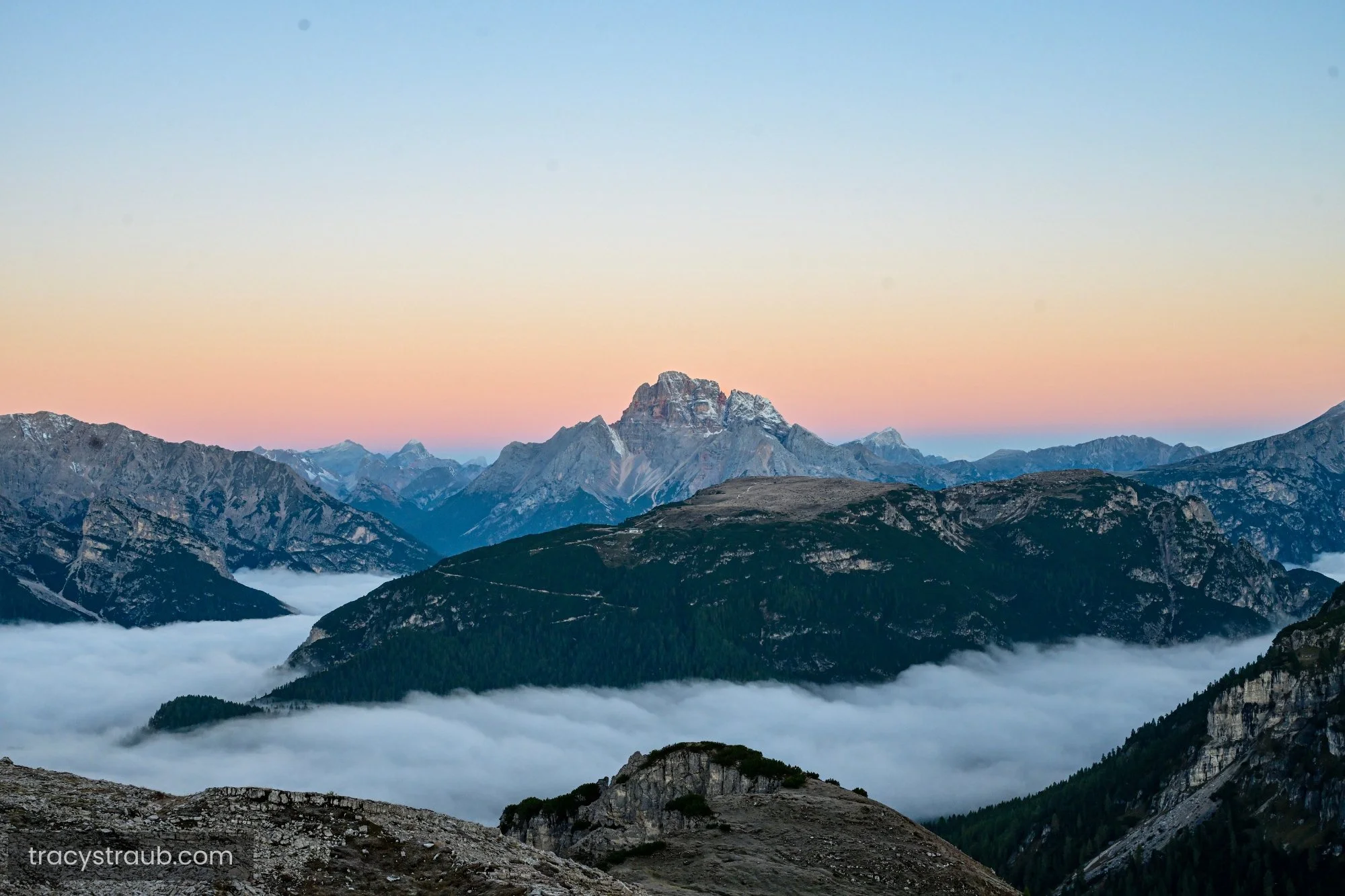
Cadini di Misurina, near Rifugio Auronzo, Località Tre Cime di Lavaredo, 32041 Auronzo di Cadore, Belluno, Veneto, Italy
We weren’t the only ones captivated by the view. As we set up to take photos, a small wedding ceremony unfolded on the cliffs, followed by a surprise engagement a few steps away. It was a beautiful reminder of how deeply this place moves people from all over the world.
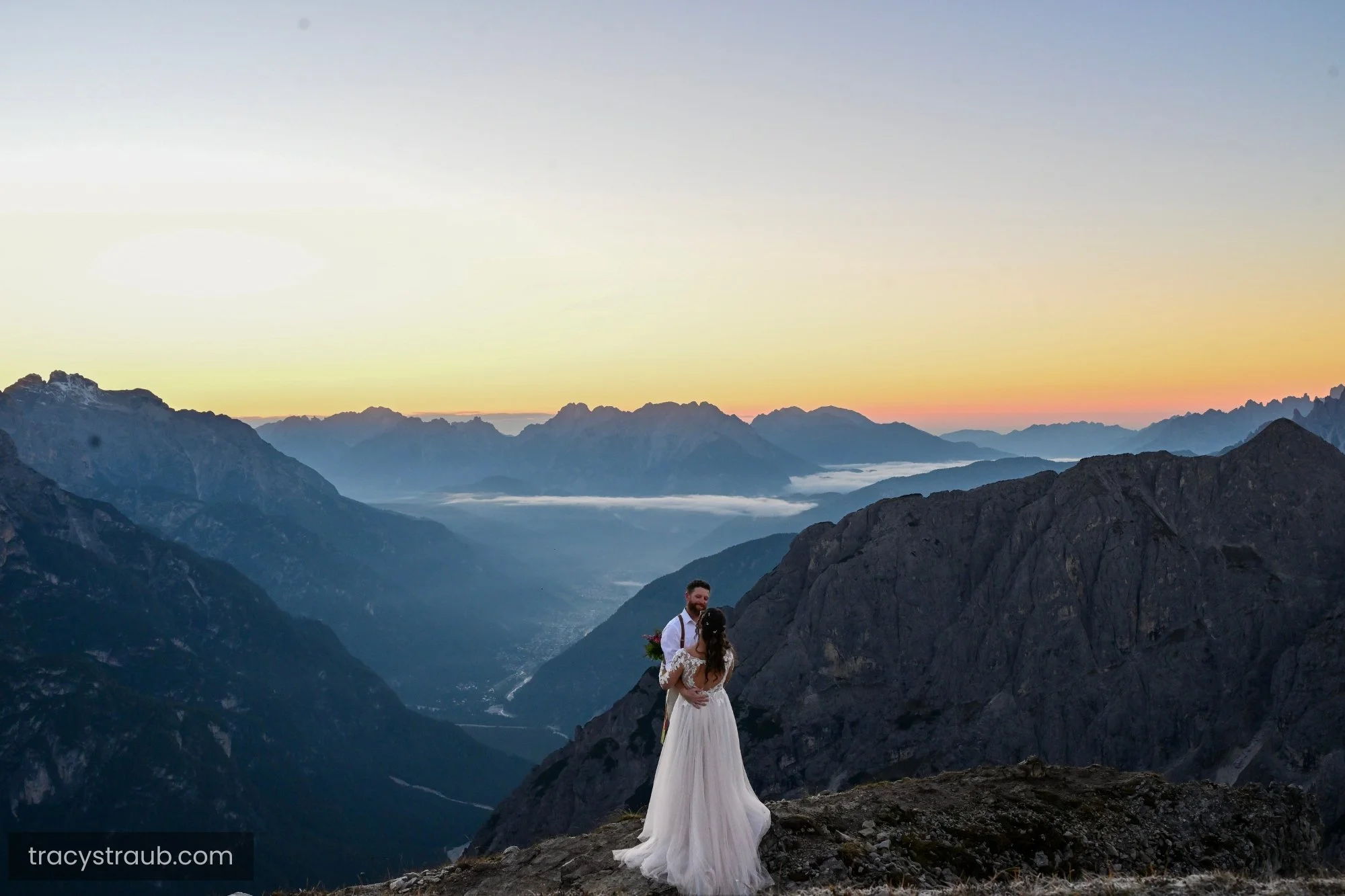
Cadini di Misurina, Dolomites, Italy
A quiet morning on the trail turned magical when I came across a bride and groom posing for a photoshoot among the jagged peaks of the Cadini di Misurina.
After sunrise, we stopped inside Rifugio Auronzo to warm up with cappuccinos and donuts before setting out on the Tre Cime di Lavaredo Loop, one of the Dolomites’ most iconic hikes. The loop is roughly 6 miles (9.7 km) long with about 1,900 feet (610 m) of total ascent, offering panoramic views of the famous Three Peaks from every angle. Starting early gave us a few quiet hours before the crowds arrived by midmorning.
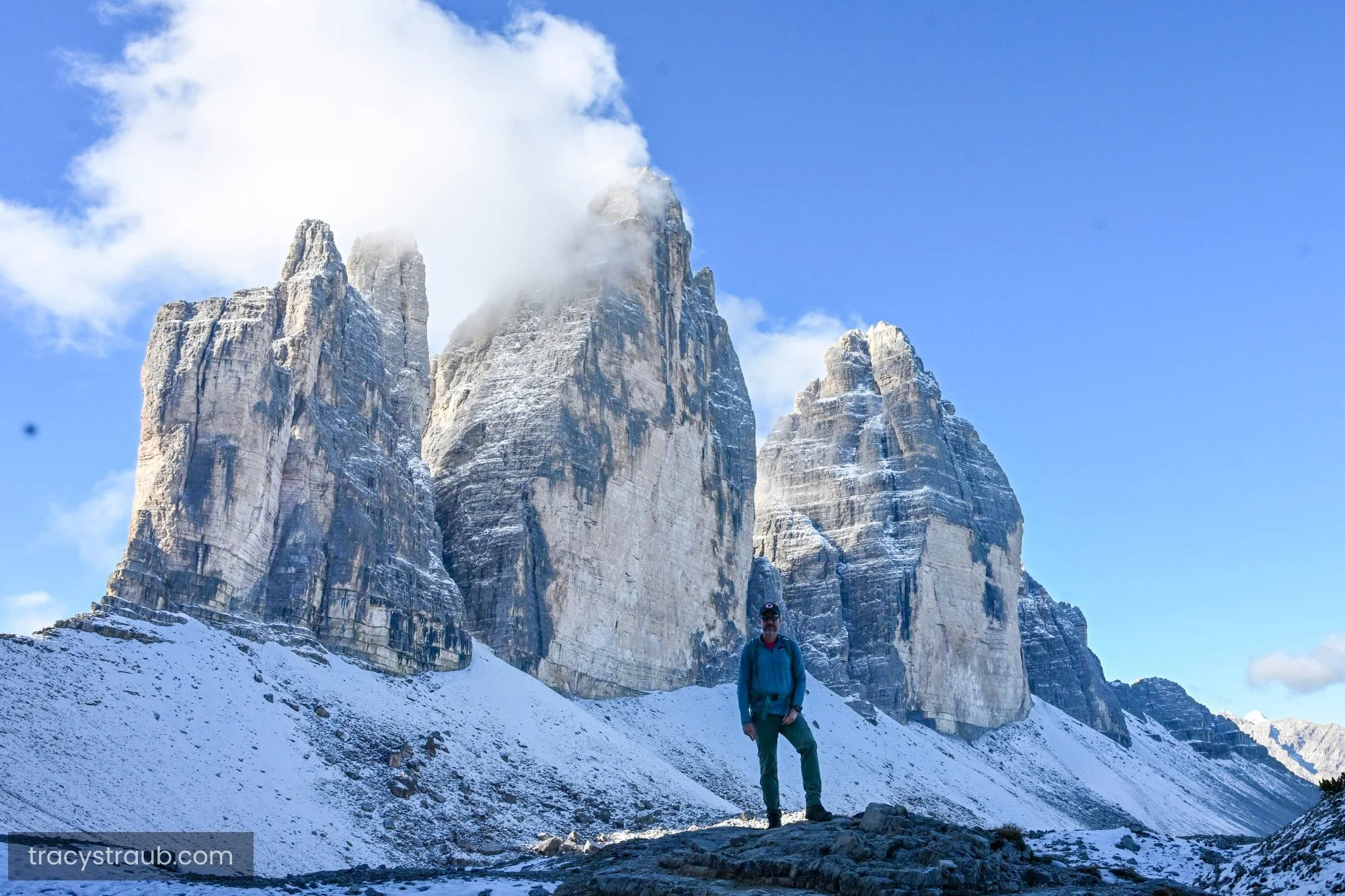
Tre Cime di Lavaredo (Three Peaks of Lavaredo), 32041 Auronzo di Cadore, Belluno, Veneto, Italy
About halfway through, we reached Rifugio Locatelli (Rifugio A. Locatelli / S. Innerkofler). It was closed for the season, but its terrace provided a perfect spot to rest and take in the sweeping views of the Dolomites.
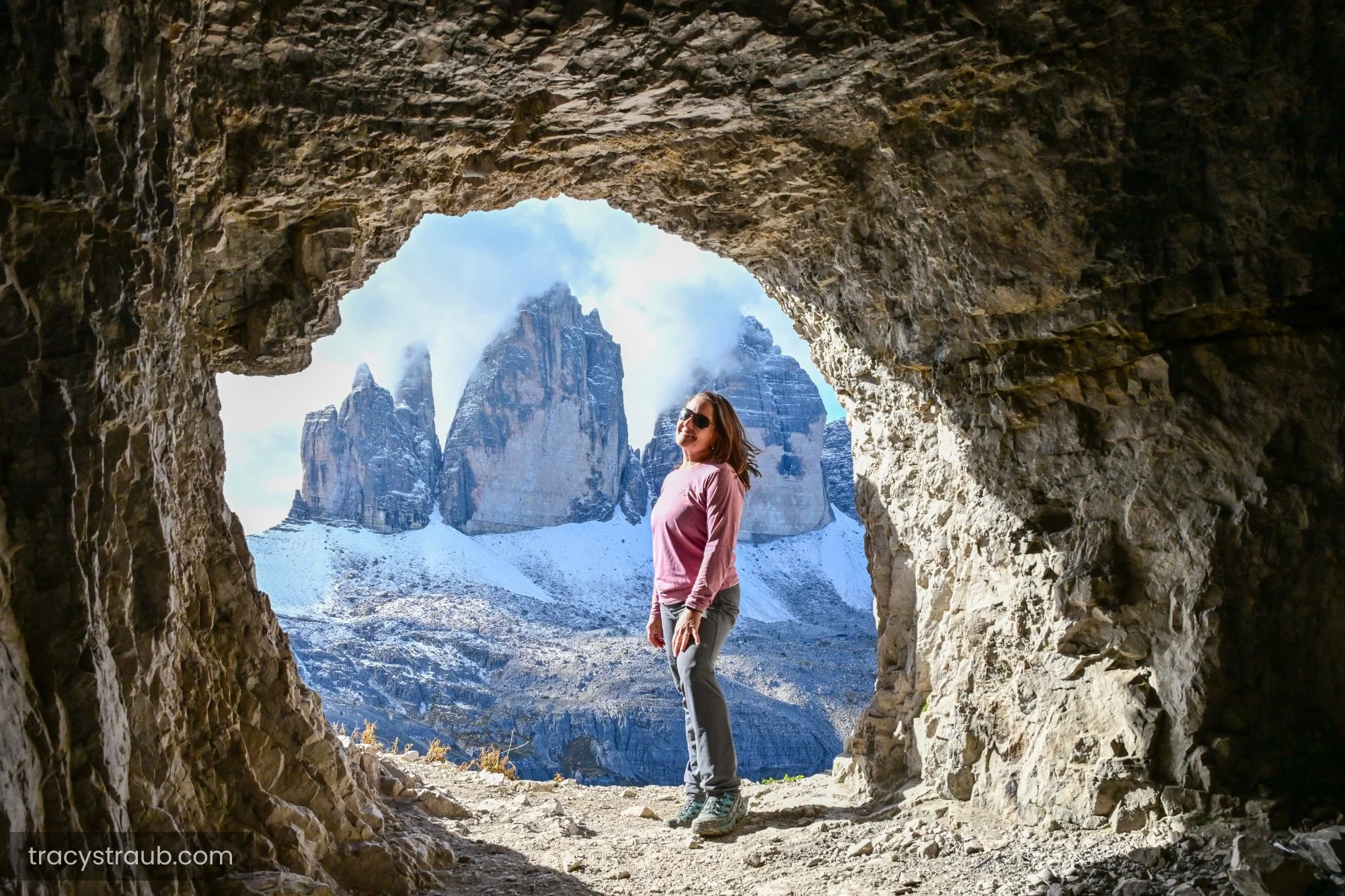
Tre Cime di Lavaredo (Three Peaks of Lavaredo), 32041 Auronzo di Cadore, Belluno, Veneto, Italy
We continued around the loop before returning to Rifugio Auronzo for a well-earned lunch. By the time we finished, we had logged nearly 10 miles (16 km) of hiking before noon and were more than ready to head back to Cortina.
That evening, we explored Cortina’s town center, where banners and signs for the upcoming 2026 Winter Olympics lined the streets. The setting sun cast a golden glow over the surrounding peaks, and the town buzzed with anticipation and pride.
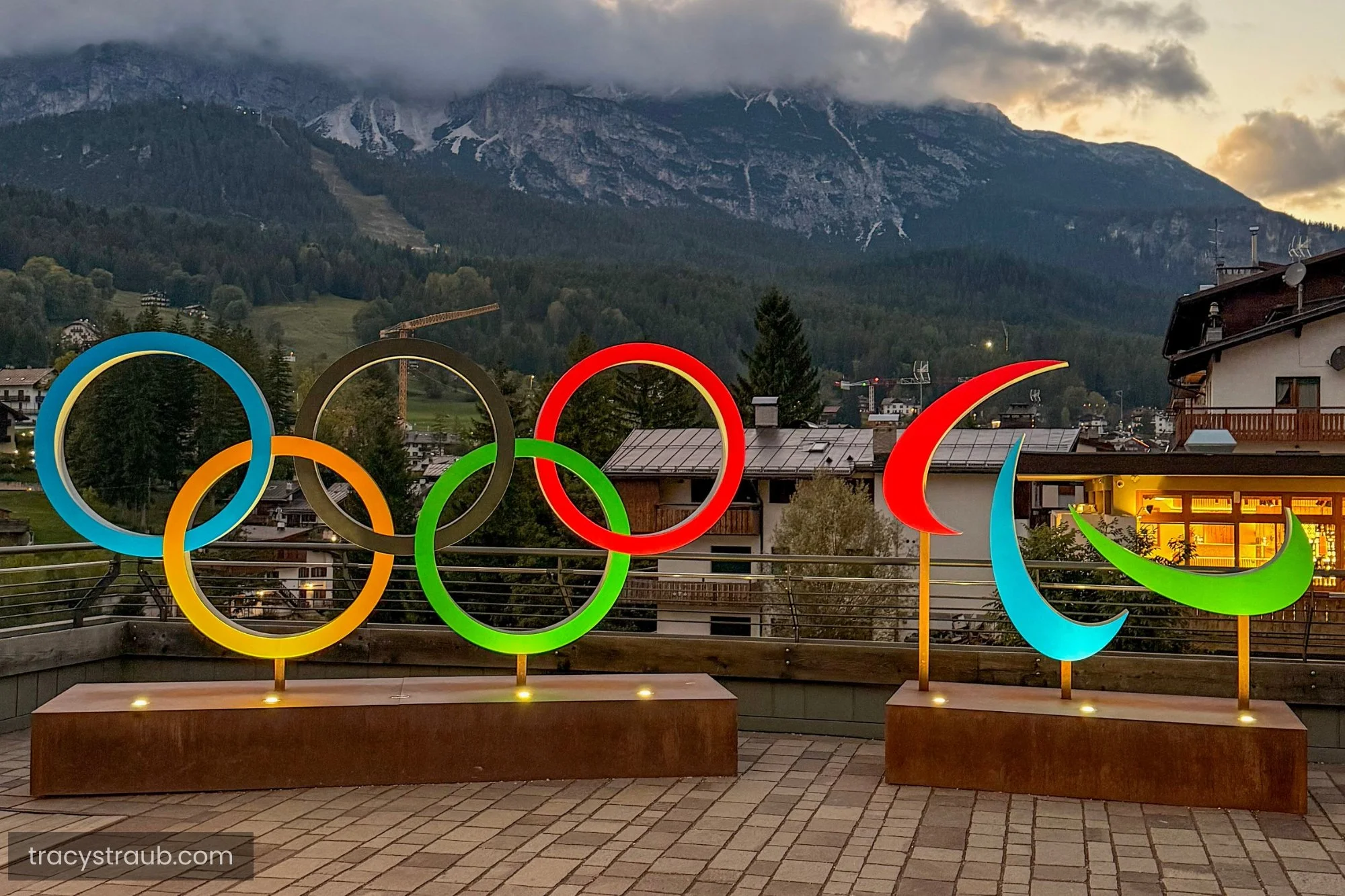
Cortina d’Ampezzo, Veneto, Italy — site of the 1956 Winter Olympics and future host of the 2026 Winter Games.
For dinner, we went to Il Vizietto di Cortina, a cozy and vibrant restaurant known for its creative Italian dishes and warm atmosphere. The meal was delicious, the service welcoming, and the energy of the town made it the perfect ending to one of our most memorable days in the Dolomites.
🏔️ Travel Notes: Cadini di Misurina & Tre Cime di Lavaredo
Drive Time:
Cortina d’Ampezzo to Rifugio Auronzo: about 1 hour (30 km)
Parking & Access:
Access to Rifugio Auronzo is via the Toll Road Tre Cime di Lavaredo (Strada Panoramica delle Tre Cime)
From 2025 onward, online reservations are required for all vehicles
The booking system allows you to select a date and time slot, enter your license plate, and prepay the €30 toll and parking fee
Bathrooms and a café are available at the parking area
Distance: 2.1 miles (3.4 km) round trip
Elevation Gain: 750 feet (230 m)
Duration: 1 to 1.5 hours
Difficulty: Short but steep, with narrow ledges near the overlook
Best Time: Sunrise for color and minimal crowds
Distance: 6 miles (9.7 km)
Elevation Gain: 1,900 feet (610 m)
Duration: 3 to 4 hours
Starting Point: Rifugio Auronzo
Route: Clockwise offers a gradual climb and ideal morning light on the peaks
Highlights: Rifugio Auronzo, Rifugio Lavaredo, and Rifugio Locatelli viewpoints
Seasonal Notes:
The toll road and rifugios typically open in late May or early June and close in late October, depending on snow
Expect snow or ice patches at higher elevations in early autumn
Bring layers, gloves, and a hat even if the forecast looks clear
Photography Tips:
For sunrise at Cadini, arrive 45 minutes before first light
A wide-angle lens captures the entire Cadini panorama
Late afternoon light is best for photographing Tre Cime from the Locatelli side
Dining:
Il Vizietto di Cortina, Via Cesare Battisti 64 – lively, modern Italian restaurant with exceptional pasta and seafood; reservations recommended
Olympic Note: Cortina continues to transform as it prepares for the 2026 Winter Games, with new infrastructure and renovated venues giving the historic town a renewed sense of excitement and energy.
Day 10: Lago di Braies Reflections & Cinque Torri Hike at Passo Giau, Dolomites
We left Cortina d’Ampezzo just after sunrise for Lago di Braies (Pragser Wildsee), one of the most photographed lakes in the Dolomites.

Sunrise view from our Airbnb apartment in Cortina d’Ampezzo, Belluno Province, Veneto, Italy
The 50-minute drive wound through quiet alpine valleys, and when we arrived around 8 a.m., the water was perfectly still, reflecting the surrounding peaks and boats like glass.
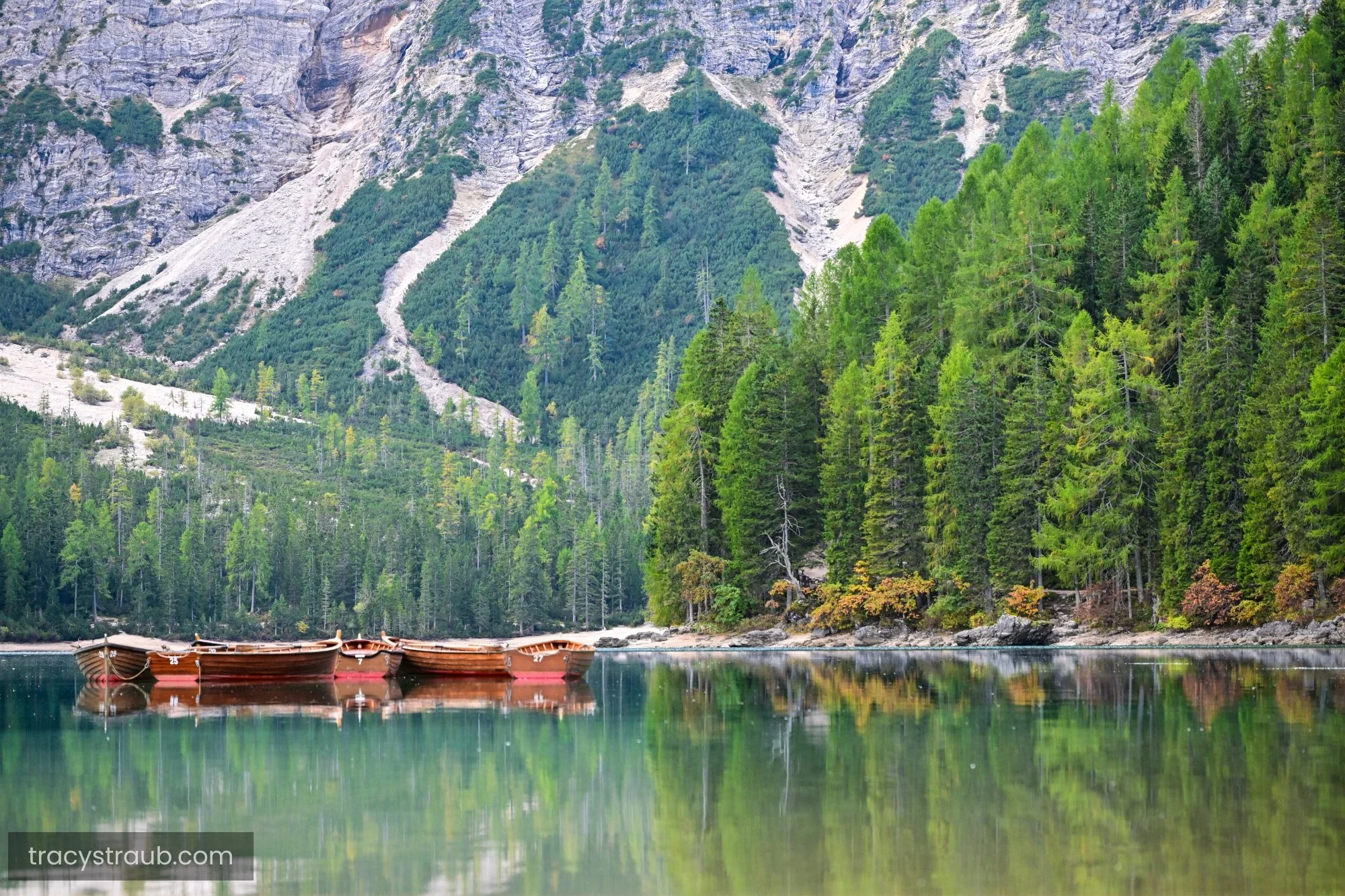
Lago di Braies (Pragser Wildsee), 39030 Braies, South Tyrol, Italy — a crystal-clear alpine lake framed by pine forests and the Croda del Becco peak in the Dolomites.
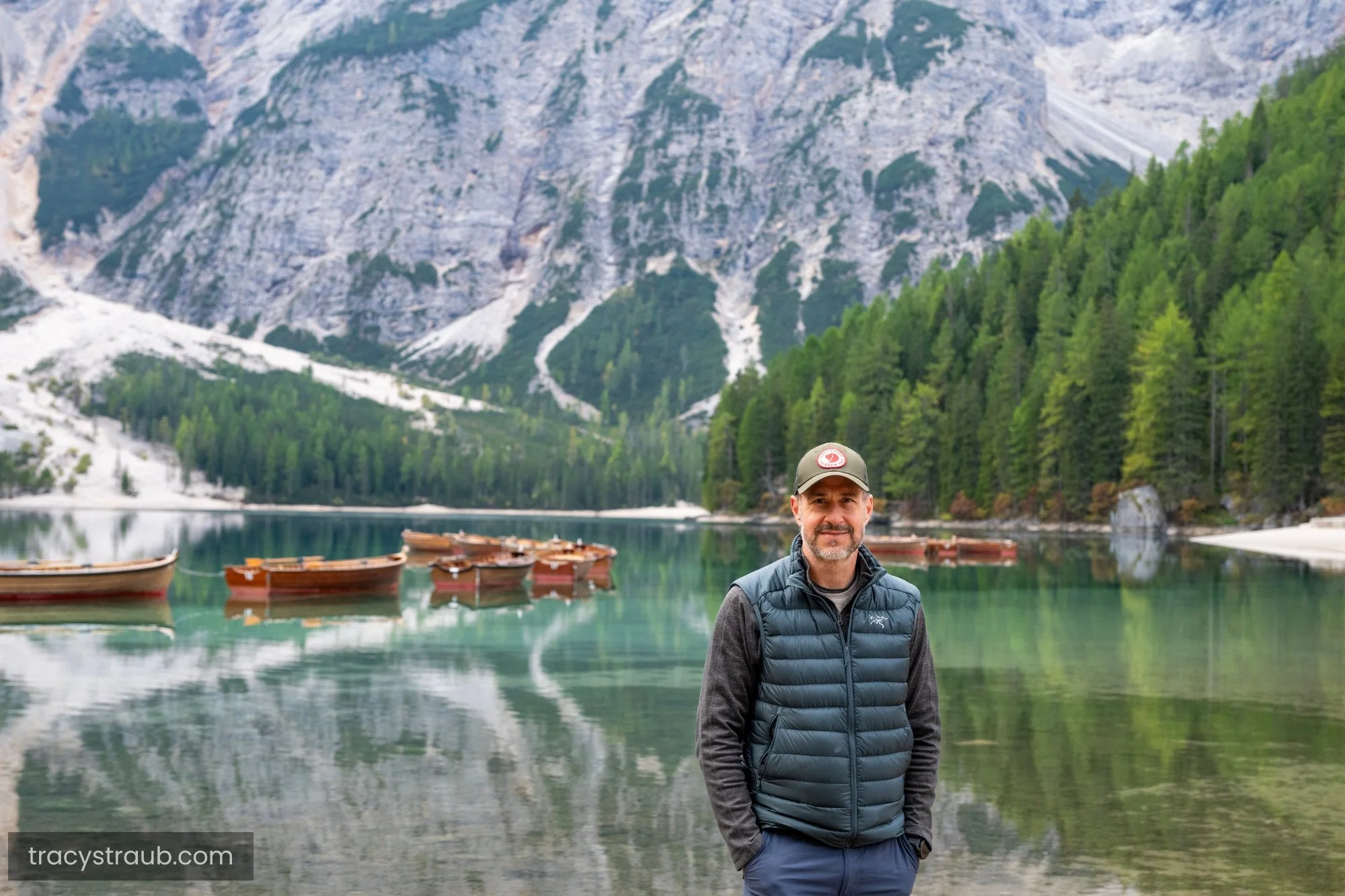
Ryan in front of Lago di Braies (Pragser Wildsee, South Tyrol, Italy.
A wedding was being set up on the dock, the rowboats adorned with flowers. Boat rentals were delayed, but watching the ceremony unfold on the lake was beautiful.

Wedding preparation at Lago di Braies (Pragser Wildsee), 39030 Braies, South Tyrol, Italy.
As we left Lago di Braies, we stopped at the little café just outside the entrance for cappuccinos and croissants to go, the perfect mid-morning treat. By then, around 9:45 a.m., the parking lot was nearly full, a good reminder to always start early at popular spots like this.
From there, we continued toward Passo Giau, one of the Dolomites’ most scenic mountain passes, where we took the chairlift up to explore Cinque Torri, a dramatic cluster of limestone towers rising from the alpine landscape. The area also serves as an open-air World War I museum, with historic trenches and tunnels winding through the trails, a striking contrast to the natural beauty surrounding it.
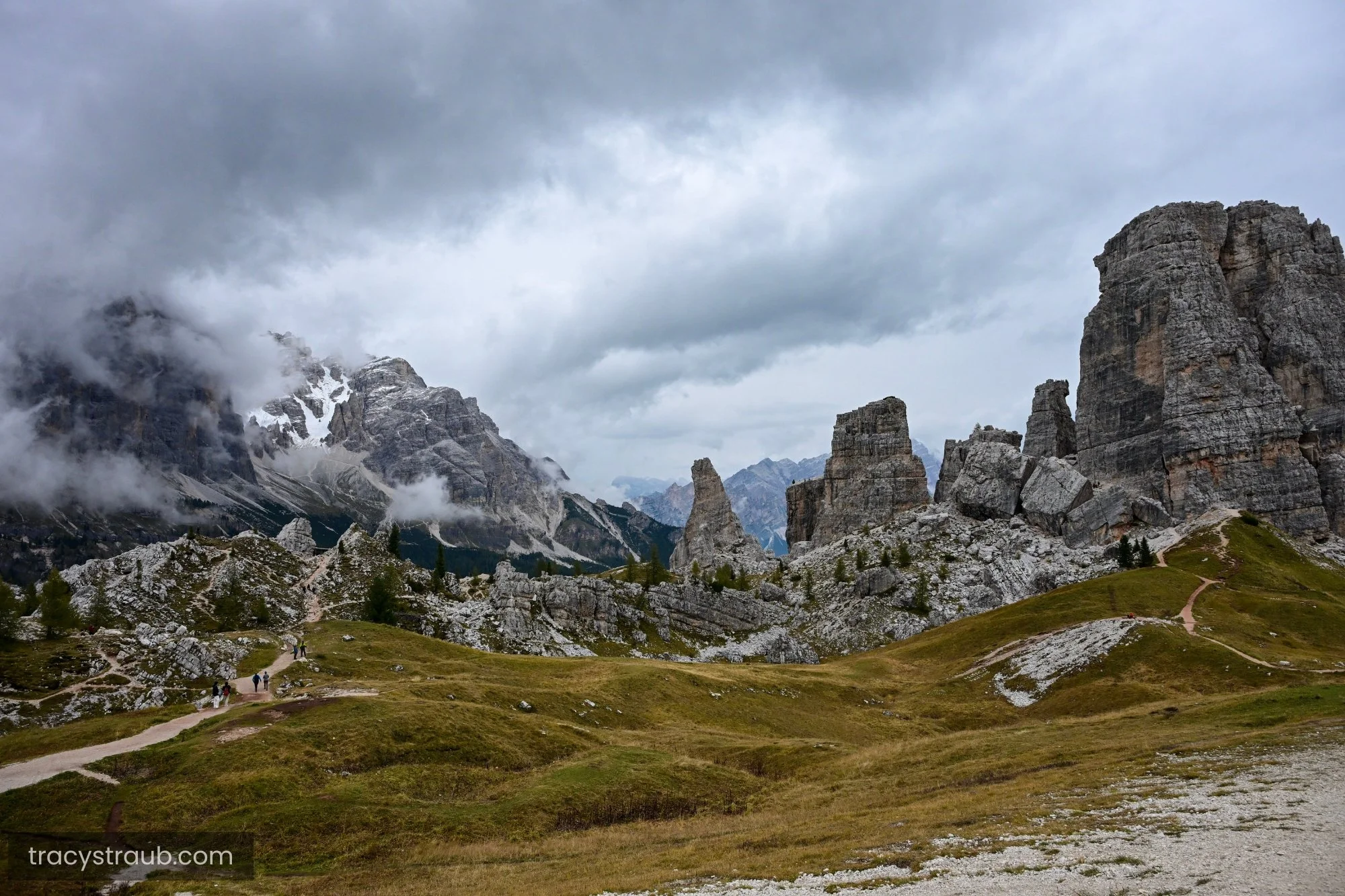
Cinque Torri, Passo Giau area, 32043 Cortina d’Ampezzo, Belluno, Veneto, Italy
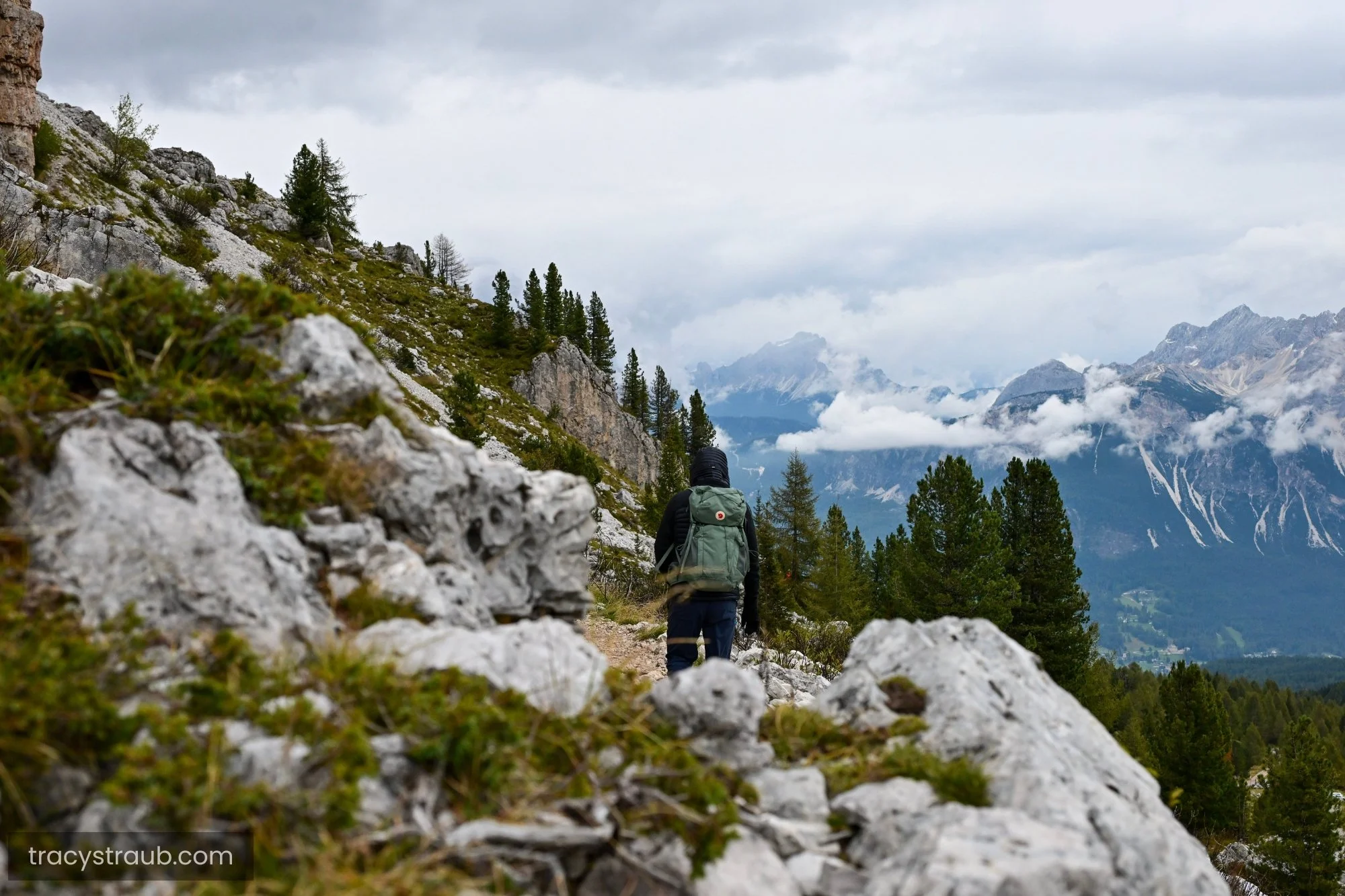
Cinque Torri, Passo Giau area, 32043 Cortina d’Ampezzo, Belluno, Veneto, Italy
We stopped at Rifugio Scoiattoli for a hearty lunch of speck, eggs, and potatoes, paired with an IPA and finished with powdered sugar doughnuts stamped with tiny hearts. The setting was lively yet peaceful, with views stretching across endless peaks.
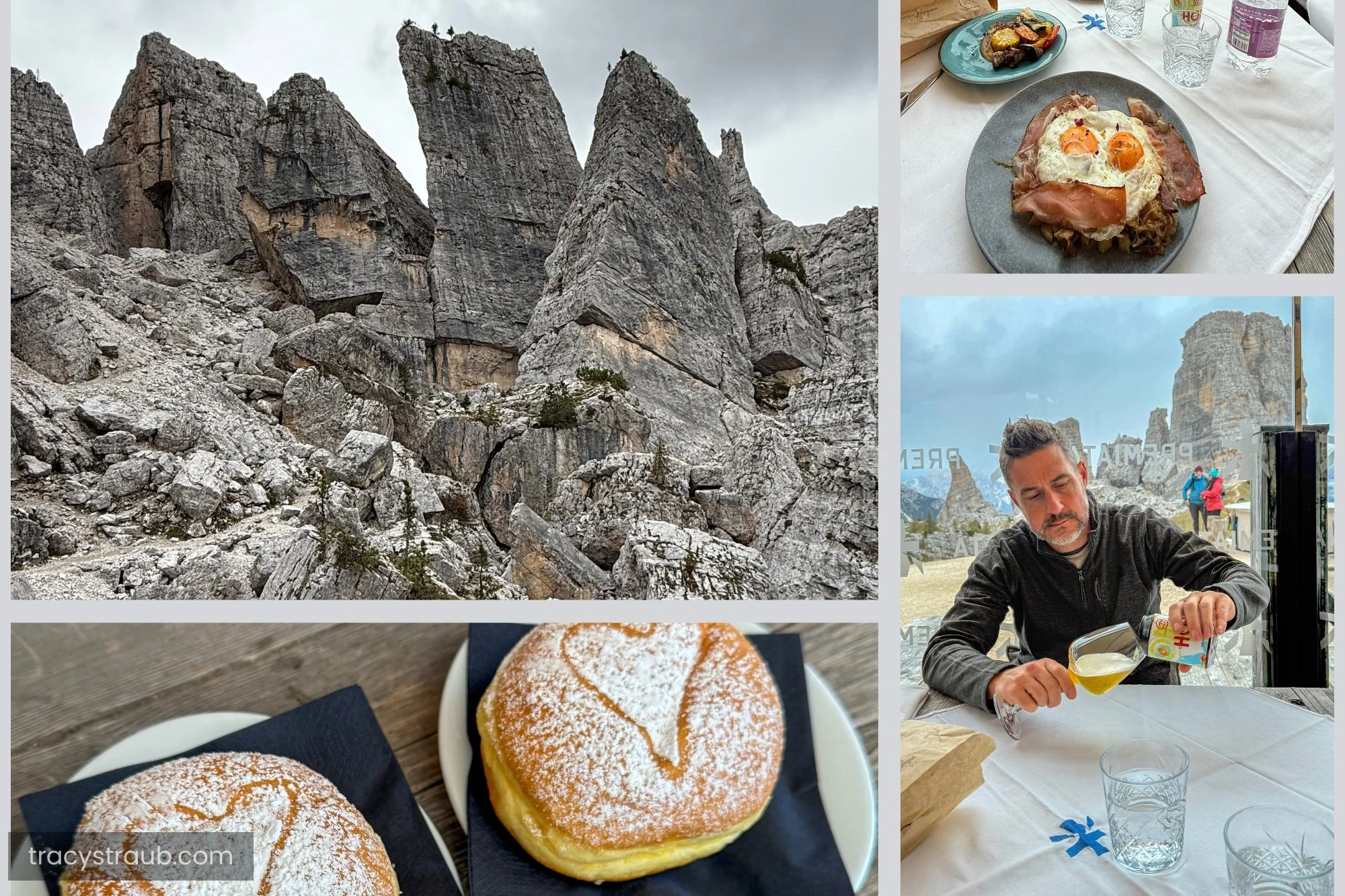
Cinque Torri, Passo Giau area, 32043 Cortina d’Ampezzo, Belluno, Veneto, Italy
Later that afternoon, we returned to Cortina for our final evening in town and dinner at The Roof, a modern restaurant overlooking the valley. Watching the lights of Cortina twinkle below as the sky turned from gold to deep blue was the perfect ending to our last full day in the Alps.
🏔️ Travel Notes: Lago di Braies & Cinque Torri at Passo Giau
Drive Times:
Cortina d’Ampezzo to Lago di Braies: about 50 minutes (52 km)
Lago di Braies to Passo Giau: about 1 hour 45 minutes
Passo Giau to Cortina d’Ampezzo: about 35 minutes
Lago di Braies Tips:
Visiting the lake is free, but parking is paid and varies by lot.
P4 Parking is the closest to the lake and also the most expensive; arrive early if you prefer that convenience.
Reservation Requirement: During high season (July–September), parking and lake access require an online reservation with a designated arrival time. Walk-in entry is not guaranteed.
Boat Rentals: Operate seasonally from late May to October, weather permitting. Private events (such as weddings) may temporarily delay or restrict rentals.
Best Light: Early morning for still reflections and soft light before wind and crowds pick up.
Café: Small espresso bar near the entrance offers pastries and sandwiches.
Cinque Torri & Passo Giau:
Chairlift: Seggiovia Cinque Torri
Trail Access: Multiple short loops connect Rifugio Scoiattoli, Rifugio Cinque Torri, and the open-air WWI museum.
Duration: 2–3 hours exploring trails and museum paths.
Difficulty: Easy to moderate, suitable for most hikers.
Highlights: Panoramic views of Tofane, Croda da Lago, and Lagazuoi.
Rifugio Scoiattoli:
Perched directly in front of the Cinque Torri, Rifugio Scoiattoli can be reached by hiking Trail No. 440 from the state road between Cortina and the Falzarego Pass (just below Pian dei Menìs) or by taking the Cinque Torri chairlift.
The refuge is known for its warm hospitality and exceptional alpine cuisine. Try the “Violets with Flavours from the Wood,” a house-made pasta delicately infused with blueberries, or pair a traditional Tyrolean dish with one of their excellent Italian or European wines, available by the glass.
Save room for dessert. The homemade sweets are a highlight. Favorites include chocolate salami with vanilla cream and the freshly prepared Squirrel Meringue, both made with creamy, locally sourced cottage cheese.
Dining:
The Roof, Cortina d’Ampezzo – stylish restaurant with contemporary alpine cuisine and panoramic evening views; reservations recommended.
Photography Notes:
Lago di Braies is most reflective on calm mornings before 9 a.m.
Cinque Torri glows beautifully in late-afternoon light, especially near golden hour.
What to Bring: Layers, hiking boots, sun protection
Day 11: Lago di Sorapis & A Venetian Farewell to the Italian Dolomites
Our final day in the Dolomites began before sunrise with one last alpine adventure: Lago di Sorapis, a glacial lake famous for its surreal turquoise color and dramatic mountain backdrop.
We packed up early, checked out of our Cortina Airbnb, and drove about twenty minutes to the Passo Tre Croci trailhead, arriving just after 7:30 a.m. Parking is limited and fills quickly, so arriving early is essential for both a space and a quieter experience on the trail.
The hike to Lago di Sorapis is about 6.2 miles (10 km) round trip with roughly 1,400 feet (430 m) of elevation gain. The trail begins through pine forest before opening to wide views of the rugged Dolomite peaks. The final stretch includes narrow ledges and metal cables for stability, but it’s manageable for most hikers with good footwear and a bit of caution.
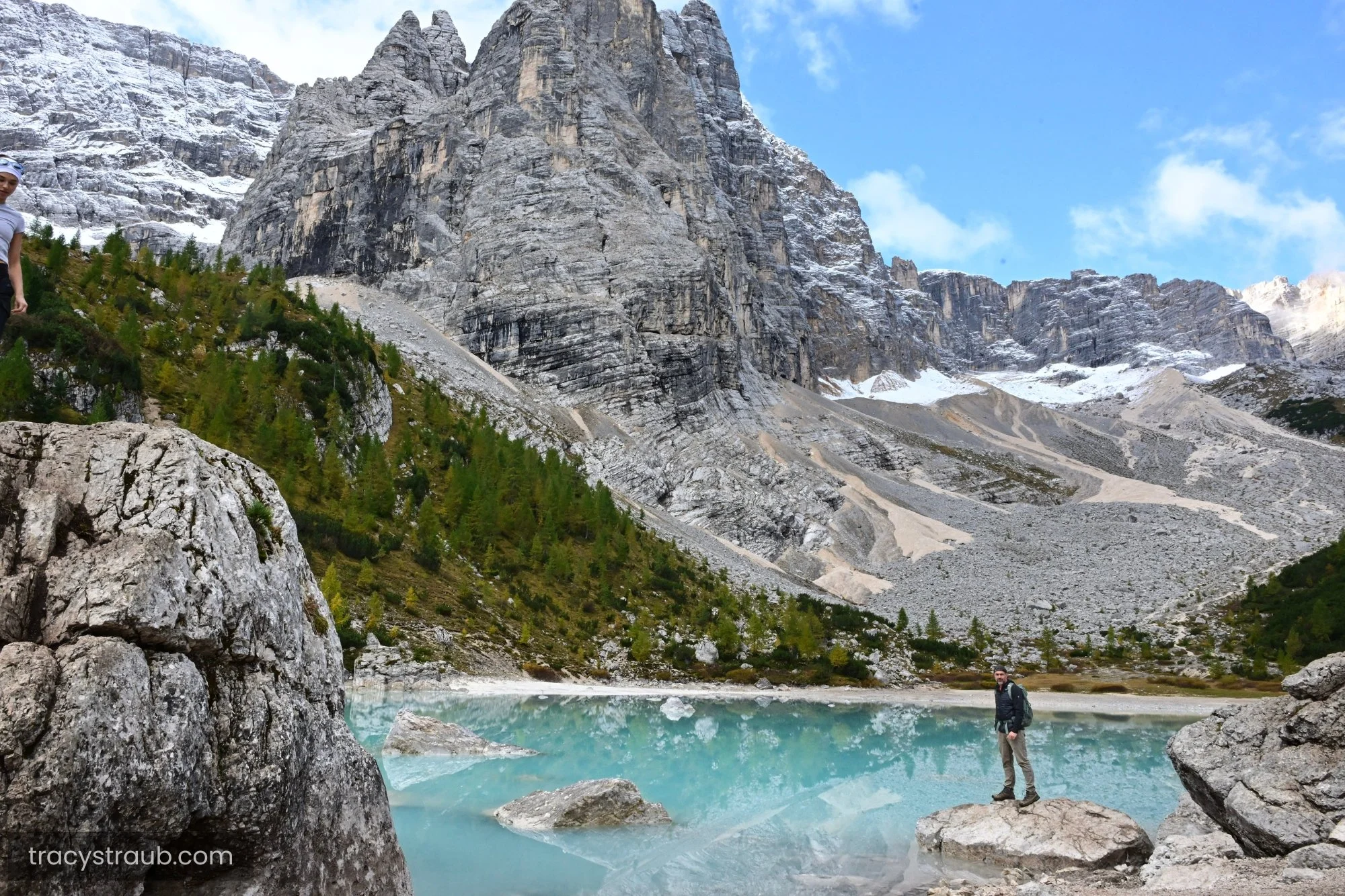
Lago di Sorapis, Cortina d’Ampezzo, Veneto, Italy

Lago di Sorapis, Cortina d’Ampezzo, Veneto, Italy
There are no facilities at the lake, so pack snacks, water, and layers for changing mountain weather. The small café at Passo Tre Croci is open seasonally and makes a nice stop for coffee after your hike.
⛰️ Hiker’s Tip: Lago di Sorapis
Trailhead: Passo Tre Croci, about 20 minutes from Cortina d’Ampezzo
Route: Trail No. 215 to Lago di Sorapis
Distance: 6.2 miles (10 km) round trip
Elevation Gain: 1,400 ft (430 m)
Duration: 3.5–4 hours round trip at a moderate pace
Difficulty: Moderate; narrow ledges with metal cables for support
Best Time to Start: Before 8 a.m. to secure parking and avoid crowds
Essentials: Sturdy hiking shoes, water, layers, and snacks; no facilities at the lake
By early afternoon, we began the drive toward Venice for one final night in Italy. That evening, we wandered through quiet canals, crossed arched bridges, and lingered in hidden piazzas far from the crowds.
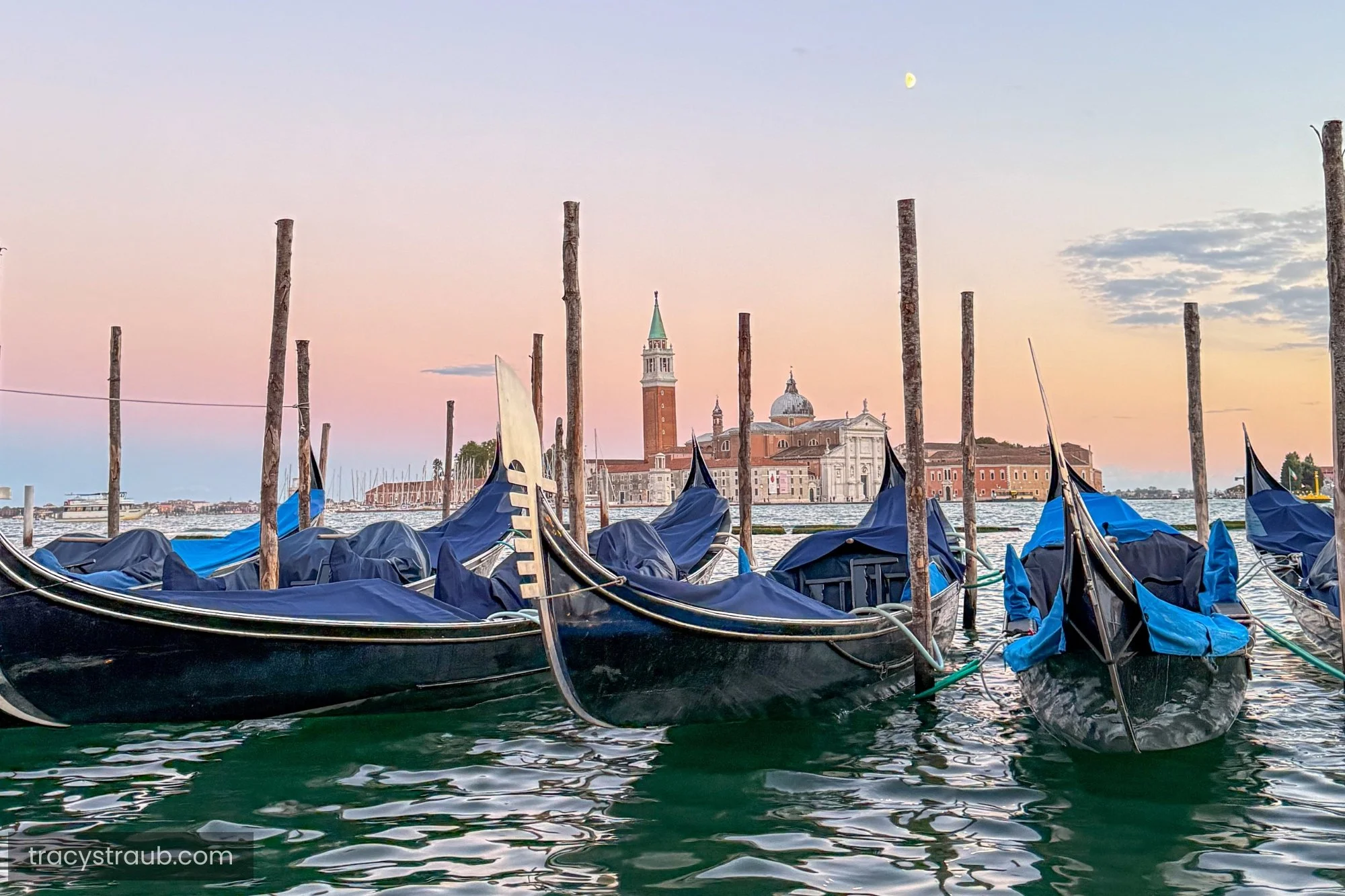
Venice, Metropolitan City of Venice, Veneto, Italy
The city felt softer in the late-day light, its reflections shifting with each passing boat. As the sun set over the lagoon, the sky turned gold and pink and the water glowed, marking the perfect end to an unforgettable journey through Austria and the Italian Dolomites.
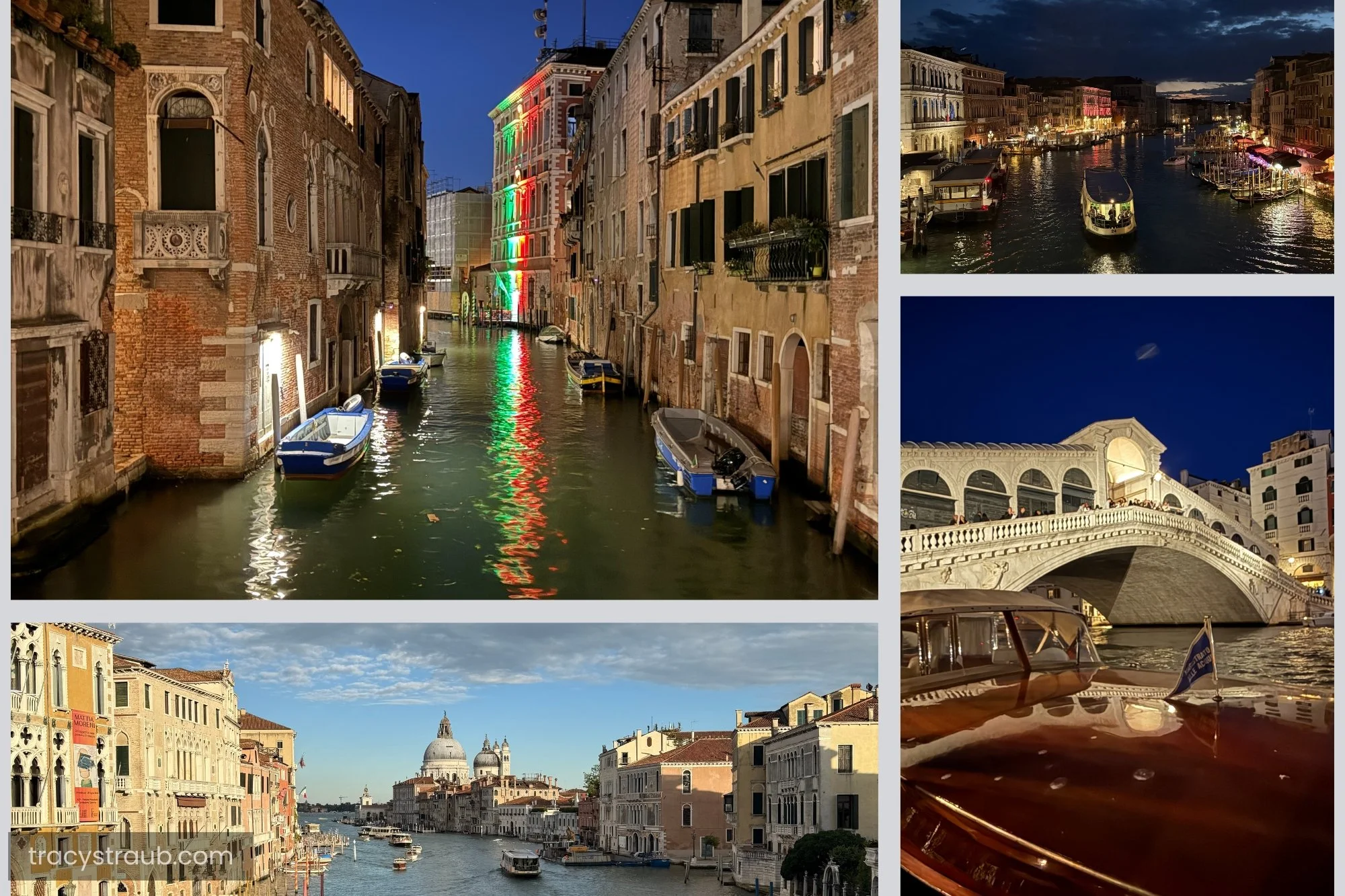
Venice, Metropolitan City of Venice, Veneto, Italy
The next morning came early. We left our hotel in Venice at 3 a.m., returned our rental car, and joined the long check-in line at the airport. From Venice, we flew to Amsterdam, then to Atlanta, and finally home to West Virginia.
✈️ Travel Tip: Venice Departure
For our final night in Italy, we stayed at the Four Points by Sheraton Venice Mestre, a comfortable and convenient hotel located about 15 minutes from the airport. It was a great choice for an early-morning departure. The property offers free parking, a restaurant and bar on-site, and modern, quiet rooms perfect for a short rest before a long travel day.
Airport: Venice Marco Polo Airport (VCE)
Car Return: The rental car facility is located in the multilevel parking structure directly across from the main terminal and operates 24 hours a day. We dropped off our Avis rental car at 3:30 a.m. utilizing their key drobox.
Timing: Arrive at least 3 hours before your international flight to allow for car return, check-in, and long security lines.
Transfers: If you’re staying in central Venice, water taxis and vaporettos run between Piazzale Roma and the airport. For early flights, staying near Mestre or the airport makes departure much easier.
Overnight Parking: For travelers spending a night in Venice proper, Garage San Marco and Tronchetto Parking near Piazzale Roma are the most convenient options.
What the Italian Dolomites & Austrian Alps Taught Me
As we boarded our flight home, I kept thinking about how this trip ended up being less about conquering new terrain and more about reconnecting with what we love most: the rhythm of the trail, the reward of a good climb, and the quiet satisfaction of sharing a simple meal after a long day outside.
The Dolomites and Austrian Alps offered it all. Unforgettable hikes, genuine hospitality, and a culture that balances adventure with ease. It was everything we hoped for, just not in the order we originally planned.
And maybe that is the real takeaway. Even with years of exploring behind us, this trip reminded us that you can map out every detail, but the moments that stay with you often come from the parts you never expected. The pivot we made at the start didn’t just save the trip; it shaped it into something better. The same holds true off the trail: plans are useful, but flexibility is what actually moves you forward.
Thank you for reading and for being part of this adventure. Be sure to follow me on Instagram for more pictures and adventures!
📸 Photography & Gear I Use on the Trail
Many of the moments from this trip, from the sunrise over Cadini di Misurina to the reflections on Lago di Braies, were captured with the gear I rely on for every adventure.
If you are planning your own trip through the Alps or simply looking to upgrade your travel essentials, you can explore my favorite photography equipment and hiking gear. These are the cameras, lenses, and trail-tested items that I personally use and recommend:
Camera Equipment
Favorite Hiking Boots/Shoes
Favorite Gear
This blog may contain affiliate links. If you make a purchase through one of these links, I may earn a small commission at no additional cost to you. Your support helps me continue creating travel guides, photography resources, and stories like this one. As an Amazon Associate, I earn from qualifying purchases.